Music Therapy

Frequently Asked Questions 

  • What is Music Therapy?

    Music Therapy is the use of music and musical activities in conjunction with inter-personal skills to accomplish therapeutic goals: to restore, improve, or maintain mental and physical health. Through carefully planned musical experiences, the client is provided with opportunities to develop potential growth. One might also describe a music therapist as one who uses music as a tool in doing therapy. Music therapists may work with any age group and a variety of disabling conditions. As a member of a therapeutic team or private practitioner, the music therapist participates in the analysis of individual problems and the establishment of treatment goals before planning and carrying out music-related treatment.
  • What does one study in the graduate music therapy program ?

    The graduate music therapy program offers a 40.5 credit combination of supportive psychology and research courses, music therapy courses in assessment, clinical improvisation techniques, group music therapy (experiential and client centered) and teaching and supervision. All of these courses include applied work. 

    The thesis seminar , two relevant electives and final thesis offer the opportunity for the student to complete professional level writing in the discipline. 
     
  • Who should apply to the program ?

    Students who have a degree in music therapy or music (generally 60 undergraduate music credits) may apply. Otherwise, please see our certification program
     
  • What if I have no prior music therapy training ?

    Undergraduate prerequisite courses in music therapy will be added to your program. You may take undergraduate and graduate courses concurrently.
     
  • What is distinctive about this program ?

    Known as a comprehensive, eclectic music therapy program since 1969, Montclair State prides itself on the ability to provide you with excellent clinical placement experiences, careful academic advisement and nationally and internationally known faculty, in both the music therapy program ,the music school and departments you may wish to explore while here (gerontology, child life, psychology, learning disabilities, special education, behavioral neuroscience).

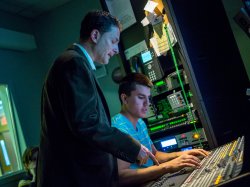
    Another unique feature is the David Ott Laboratory for Music and Health. The Ott Lab's resources for reseach and practice in the psychology of music include: interactive sensors for physiological feedback during both active and receptive music experiences; computer hardware for recording and display of data; iPod for music storage and retrieval; Somatron for vibro-acoustic experiences; and a variety of musical instruments for active music making. Students gain a practical understanding of these resources, and practice in collection and presentation of physiological data to inform clinical intervention and music therapy research.

    The Laboratory's mission supports the development of research skills for students, interns, graduates, practicing clinicians and collegial academic institutions. Students conduct research oriented toward physiological outcomes of music and music therapy interventions and publish results in a variety of scientific journals. The practical experience gained in the Lab is applicable to their work as practicing music therapists. (For more information, contact Ott Lab Coordinator Dr. Eric Miller, millerer@mail.montclair.edu.
     
  • Where do some of your graduates from this program work ?

    Since the graduate program began in 1998, many gifted clinicians who came to Montclair from local as well as national and international locations, have completed the program and gone on to make significant professional music therapy contributions in the clinical areas of eating disorders, rehabilitation, gerontology, visually impaired, autistic spectrum disorders, adult psychiatry , oncology, adaptive music education and neonatal intensive care.
     
  • Are scholarships and other financial aid available?

    The David Ott Fellowship is awarded to an incoming matriculated graduate music therapy student and provides a total of $4000, with $1000 awarded each semester for four semesters. The Cali School provides scholarships on a competitive basis to music majors who apply and meet additional requirements. Many of these scholarships are awarded to students who are already enrolled as they continue their studies.

    Prospective students are advised to keep in mind that MSU's tuition is quite reasonable compared to many other schools, leading to less need for large scholarship assistance than at more expensive schools. Additional information on financial aid is available from the MSU Financial Aid Office at http://www.montclair.edu/financialaid or 973-655-4461.
     
  • Where can I find additional information?

    For those unfamiliar with music therapy, it is a good idea to begin some music therapy reading or arrange for observation of a music therapy session. Suggested introductory readings are provided below. You may call the Music Therapy graduate coordinator for a list of music therapists working in New Jersey.

    Music Therapy Days—The Cali School and the College of the Arts offer informational programs several times a year for prospective students. Learn about music therapy as a field and career choice, and about MSU's program. Highlights will include opportunities for networking; options for class visits; and open discussion with the music therapy faculty. Visitors may come for all or part of the day. For more information, see Arts Day Events for dates and schedules.

    If you have additional questions, please contact:
    Prof. Brian Abrams
    Graduate Coordinator
    Tel: (973) 655-3458
    Email: abramsb@mail.montclair.edu
    or write c/o 
    Cali School of Music
    Montclair State University
    1 Normal Avenue
    Montclair, NJ 07043
     
  • Introductory Readings - Books

    Bruscia, K. (Ed). (1991). Case Studies in Music Therapy. Gilsum, NH: Barcelona.
    Davis, W. B., Gfeller, K., Thaut, M. (1997). An Introduction to Music Therapy: Theory and Practice. 2nd Edition. Boston: McGraw Hill.
    Goodman, K.D. (2007) Music Therapy Groupwork with Special Needs Children : The Evolving Process. Springfield, Ill: Charles C. Thomas
     
  • Journals and Web Resources

    The Arts in Psychotherapy
    AMTA - American Music Therapy Association
    CBMT - Certification Board for Music Therapy
    Music Therapy World
     

Audition Information

See course listings from the MSU Graduate Catalog.