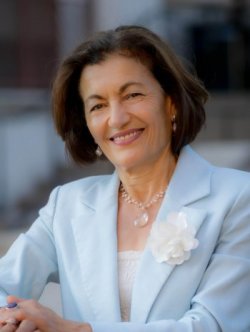
Montclair State University will have some large shoes to fill when its two most tenured deans step down in June. Ada Beth Cutler, the dean of the College of Education and Human Services, will return to the classroom, while Geoffrey Newman, the dean of the College of the Arts, is retiring and plans to write, travel, and work on a variety of projects. We asked each of them to reflect on their remarkable careers before beginning this new chapter in their lives.
Ada Beth Cutler
Dean Cutler’s expertise in teacher learning, school-university partnerships, and education policy is no secret to those in the field. The Harvard graduate has written numerous articles and book chapters, and is a highly regarded speaker in education circles.
Q:
President Cole has referred to you as the best education dean in the country. How
do you feel about that recognition?
A: I’m both
embarrassed and proud. Embarrassed because it’s an over-the-top compliment, and
there are other education deans I admire and respect who deserve that designation
more than I do. But proud because there is no one in my professional life whom
I admire and respect more than President Cole. She has been my mentor, my
biggest supporter, my advisor, my teacher, and my friend. Who could ask for
more in a boss?
Q: What is
it you are most proud of during your tenure as dean?
A: During my
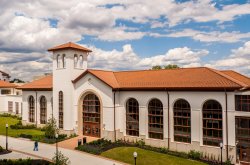
tenure, we planned and built our magnificent home in University Hall. But as important
as this new facility has been, it does not compare to the faculty and staff we
have attracted and retained over the past 12 years. Of our 115 full-time
faculty, 86 joined us during this time. As leader of the College, I know that
almost all of the credit for what we’ve accomplished during my tenure goes to my
associate and assistant deans and directors, the professional and classified
staff, and the faculty. They are the heart, soul, and engine of this College.
Q:-Why
were you originally attracted to Montclair State in 1994, when you joined the
faculty and became director of the MSU Network for Educational Renewal?
A: I grew up
in New Jersey and in high school, everyone knew that if you wanted to be a high
school teacher, Montclair State was the place to go. When I came back to the state
in 1993, I took a position as a senior research associate at the Consortium for
Policy Research in Education at Rutgers. When I saw the ad for a faculty
opening at Montclair State in the Department of Curriculum and Teaching, I knew
I had to apply.
My goal was to be a teacher educator, but I also wanted to work on school improvement and professional development. The position seemed so perfect for me. It resonated with Montclair State’s emphasis on teaching for critical thinking and partnership with schools. During my 18 years at the University, I have always felt this was my professional home—it is the institution and the community where I belong and where I knew I could make a real contribution.
Q: How
would you describe this next phase of your life and what does it entail?
A: I’m not
retiring or even semi-retiring, I’m only stepping out of the dean’s role and
staying at Montclair State as a professor. I am looking forward to my
administrative sabbatical next year when I can rejuvenate myself as a teacher and
scholar. Then I’m looking forward to a different lifestyle as a professor, with
less stress and more time to think, mentor students and younger colleagues,
conduct research and write, and to spend more time with my growing family.
Becoming a grandmother (there are five of them under the age of six) has been
life changing for me.
Q: What is
it about teaching and research that you love?
A: In 2000,
when I was contemplating accepting the position of interim dean, I told my
predecessor, Nick Michelli, that teaching brings me joy, and I asked him if
being dean could do that. He responded that a good dean is a teacher too, but
in a different way. He was right. I know now that being a teacher is a central
part of who I am whatever my job is, but I miss being in the classroom. I miss
the mentoring relationship with students and the possibility of influencing
students’ lives and careers. I miss planning how to help students learn, to
think critically, to grow intellectually, and to develop as educators and human
beings. I love teaching! In addition, there are many important questions about
teacher education, teacher development, and education policy I want to
investigate and write about in the coming years.
Q: You’ve
had many accomplishments throughout your years as dean. Which ones mean the
most to you?
A: I have
said many times that one mark of a good leader is the ability to attract, hire,
and retain outstanding people. I always try to hire people whom I can learn
from, who are as smart or smarter than I am, and then I strive to support them
so they can do their very best work. I think I’ve been able to do that and I am
very proud of that accomplishment. Aside from the growth in our student body
and new programs, including three new doctoral programs, and our national
rankings and recognitions, our home in University Hall stands out. University
Hall is a tangible and visual symbol of how important the College of Education
and Human Services is to this University, and it is everything we dreamed it should
be.
Geoffrey Newman
Montclair State will miss Geoffrey Newman’s energy and passion when he steps down as dean of the College of the Arts (CART) this June. For more than two decades, Newman has spearheaded the College’s growth into one of the nation’s top institutions for higher education in the visual, fine, and performing arts. In 2003, he established the Office of Education and Community Outreach, and the following year, the 500-seat Alexander Kasser Theater opened its doors. In 2006, the John J. Cali School of Music was established and the University Art Galleries added the beautiful George Segal Gallery to its exhibition space. And as facilities grew, so did the faculty and student enrollment.
Q: What
will you miss most?
A: The
people. After 24 years, my friends and professional colleagues have merged and
I will miss those relationships.
Q: What
has been your greatest challenge as dean?
A: My
greatest challenge has been and continues to be managing change. Change happens
each and every day. The more we do as a College of the Arts, the more is
revealed that needs to be done. Handling the issues of personnel support,
changing University goals, meeting the community, and campus academic and
non-academic needs often requires a daily assessment and then reassessment of
where I am going, where the unit is going, and the timetable for achieving
these goals. This is a moving target that needs constant attention.
Q: This
year you and the University have been hard at work to establish a new School of
Communication and Media. How do you feel about retiring just as this initiative
takes off?
A: I think
having established the new School of Communication and Media in CART is a great
joy of an achievement. I have no regrets about doing this and passing it on to
a new dean, as this will provide endless joy for him or her. I think this is
such a wonderful opportunity to build this area of study that I am sure it will
be seen as a jewel in the crown of the arts at Montclair State University.
Q: What is
your proudest accomplishment as dean and what are the milestones that you will
remember most?
A: I would
say the creation of the College of the Arts. When I arrived, there were only
three departments. We then went from a School of Fine and Performing Arts to a
College of the Arts, more than doubled the enrollment, and brought many more
faculty members to the College. I have hired more than three-fourths of the
current full-time faculty, guided the revision of curriculum, and added new
undergraduate and graduate programs. I helped to establish new and additional
facilities to every department in the College. We now have Life Hall, the DuMont
Television Center, an MFA building, Calcia Hall, plus a facility for Fashion
Studies, Graphic Design, Broadcasting offices, the Kasser Theater, a renovated
Memorial Auditorium, and the John J. Cali School of Music.
Q: How
would you like current students to describe the College of the Arts?
A: As the
soul of the University. It is the one place where students are encouraged to explore
what they do not know and understand, and come to understand who they are as
unique individuals possessing the strength and courage to be who they want to be
and can be. The College of the Arts is the safe and nurturing environment where
students, under the tutelage of faculty and staff, dare to take risks and
constantly examine how to reshape and better define the many messages hidden
inside. The College of the Arts is the creative spirit inside us all.
Q: In your
opinion, what is the biggest challenge CART graduates face today?
A: The
biggest challenge is finding ways through which one can pursue one’s dreams without
compromising one’s principles. The workplace can sometimes be very deceptive. The
workplace and organizational needs often can become more important than
individual needs, yet both must be addressed. And as things continue to change
in the workplace or organization, so must you. How to do that often becomes the
greater of the challenges.
Q: What
advice would you give your successor?
A: I would
say trust the people with whom you work. They are your greatest strength and
your most valuable resource in achieving your goals.
Q: What
are your plans for the future?
A: The future
for me is still being written. I will take all the wisdom I have learned from Montclair
State and begin to define and shape my next period of growth. I will work on
writing many of my thoughts, doing some consulting, and working on specific
projects. I look forward to becoming more bicoastal and developing connections
and opportunities in both locations. I will never be far from the University where
I have given my hopes, dreams, blood, sweat, and tears for 23 years. Carpe
Diem!