
View Profile Page
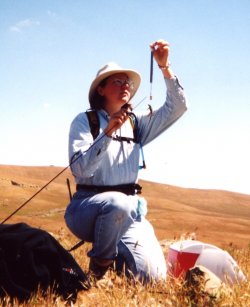
Lisa Hazard
Associate Professor, Biology, College of Science and Mathematics
- Email:
- hazardl@montclair.edu
- Phone:
- 973-655-3418
- vCard:
- Download vCard
Profile
As a physiological ecologist, my primary interest is in organism-level biology: how individual organisms function and behave, how they are influenced by their environment and their evolutionary history, and how this ultimately leads to the evolution of biological diversity. My research focuses on the physiological ecology of reptiles and amphibians, integrating lab and field studies, often with a conservation-oriented approach. My current major areas of study include the evolutionary and ecological patterns underlying osmoregulatory strategies used by reptiles with high-salt diets and the impact of anthropogenic changes to environmental salinity on temperate zone amphibian species; I am involved in several other projects as well. In both of my main areas of study, I have found fascinating variation among species in how they cope physiologically and behaviorally with environmental or dietary salts, with profound implications for the evolution of physiological traits and for the conservation of imperiled species. Students participate in all aspects of my research, and several have been co-authors on conference presentations and peer-reviewed publications.
Specialization
Conservation physiology and physiological ecology
Reptile and amphibian physiology, ecology, and natural history (emphasis on northeastern and southwestern U.S. fauna)
Links
Montclair State University does not endorse the views or opinions expressed in a faculty member's webpage or website. Consistent with the principles of academic freedom, the content provided is that of the author and does not express the opinions or views of Montclair State University.
Research Projects
Impact of salinization on New Jersey amphibian populations: A physiological approach to water quality issues
I am currently conducting field- and lab-based research investigating the effects of road salt on adult and larval amphibians. Amphibians have a permeable skin, and can absorb or lose water and other compounds readily across this surface. Road salt contamination has been demonstrated to have detrimental effects on larval amphibian survival and development, and the vernal pools of northern New Jersey may be especially susceptible to salt effects. I intend to integrate the responses of larval and adult amphibians to varying salinities, to address the overall question Will adult amphibians avoid vernal pools with salinities that would be toxic to their offspring? The answer will have profound implications for how well these species are able to adjust and adapt to changes in the water quality of their environment.
This study will use a conservation physiology approach to evaluate water quality, integrating behavioral and physiological responses of adult amphibian species of New Jersey to elevated levels of road deicers with ecological monitoring of breeding attempts by amphibians in contaminated habitats. This study has been funded by the New Jersey Water Resources Research Institute/USGS.
Distribution of ecologically important pathogens (chytrid fungus and Ranavirus) among New Jersey amphibian populations.
Amphibian populations are declining due to a variety of factors, including habitat loss, introduced species, chemical pollution, and novel pathogens. Batrachochytrium dendrobatidis (Bd) is a pathogenic fungus that has been implicated in amphibian declines and extinctions worldwide. Screening animals for this pathogen usually involves invasive histological examination of skin samples. Recently researchers at the University of Maine developed a non-invasive molecular technique to screen for Bd DNA; this technique is suitable for screening both animals and environmental samples. While much of the United States has now been surveyed, New Jersey has not yet been evaluated. We have received funding from the New Jersey Department of Environmental Protection's Conserve Wildlife Matching Grant fund to screen New Jersey amphibian species for Bd.
I am collaborating with Dr. Kirsten Monsen-Collar, also of the Department of Biology and Molecular Biology, to use this non-invasive technique to screen skin, soil, and water samples from the New Jersey School of Conservation in Sussex County, NJ. I am directing field sampling efforts, and Dr. Monsen-Collar, a molecular ecologist, is analyzing the samples. During the next year, we will sample amphibians throughout the state of New Jersey. This project will enhance amphibian conservation and management efforts within New Jersey. Funding is provided by the New Jersey Conserve Wildlife Matching Funds Grant of the New Jersey Department of Environmental Protection.
Evolutionary physiology of osmoregulation: Regulation and distribution of salt glands in lizards
Balancing input and output of salts and water is critical for animals to maintain osmotic homeostasis (constant internal conditions). A key factor in this process, therefore, is the control of excretion of major dietary electrolytes such as sodium, potassium and chloride. I am investigating the influence that ecological factors (e.g. diet and habitat) have on internal control of a basic physiological function, salt excretion, through focused studies on the salt glands of selected lizard species that vary in their diet, habitat, and evolutionary history.
Salt glands, highly specialized secretory organs, are used by some non-mammalian vertebrates to excrete dietary salts. Marine birds, sea turtles, snakes, and crocodilians secrete only sodium chloride (NaCl) via their salt glands. In lizards, the ions excreted vary with diet and species: marine species secrete primarily sodium chloride, while herbivorous species secrete primarily potassium chloride (KCl). However, in some species individuals can vary secretion composition depending on the particular load incurred.
The regulatory mechanisms controlling secretion differ among taxa: birds and most marine reptiles secrete NaCl in response to any osmotic load. Secretion in lizards is initiated in response to chloride in some species, while others secrete in response to potassium and/or chloride. I am investigating the evolution of salt glands in different families of lizards, and exploring in detail the physiological mechanisms of control of secretion (both overall rate and composition of secretions) by the glands in select species.