View Profile Page
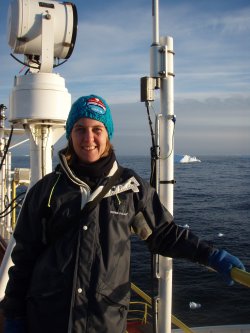
Sandra Passchier
Professor, Earth and Environmental Studies, College of Science and Mathematics
- Office:
- Center for Environmental & Life Sciences 324
- Email:
- passchiers@montclair.edu
- Phone:
- 973-655-3185
- Degrees:
- MS, University of Amsterdam
- PhD, Ohio State University
- vCard:
- Download vCard
Profile
Dr. Sandra Passchier is a professor of Earth and Environmental Science and an active member of the geoscience research community. Her research involves the collection and analysis of drillcore data to 1) study the impacts of climate change on polar ice sheets and 2) design solutions for the protection and development of urban coasts. As a principal investigator on projects funded by the U.S. National Science Foundation, she is currently targeting the stratigraphic record of West Antarctic and Northwest Greenland ice behaviors and their respective roles in global climate change and sea level rise during warm periods in Earth's past. Since 1992, Dr. Passchier has been a science team member on 8 Arctic and Antarctic field and shipboard expeditions, most recently IODP Expedition 400 to the Northwest Greenland margin.
Dr. Passchier is a sedimentologist and marine geologist. Her team studies drillcore samples using analytical methods to measure the physical properties and chemical/mineralogical composition of sediments. The objective of this research is to reconstruct the past environmental conditions and stratigraphic development of the margins of continents that once carried ice sheets. This data can be interpreted to 1) build time series of glaciation and ice-sheet retreat under different climate scenarios and 2) to assess the geological foundation and sediment mobility for modern offshore construction and coastal defenses.
Dr. Passchier is dedicated to educating the next generation of geoscientists. She acted as the primary thesis or dissertation research advisor for more than 20 graduate students, supervised the laboratory research of dozens of undergraduate students, and served separate multi-year terms as a coordinator for the B.S. and the M.S. in Geoscience/Earth and Environmental Science programs. Her teaching assignments include Stratigraphy, Advanced Marine Geology, Sedimentology, Glacial Deposits, and introductory courses in the Geosciences, such as Physical Geology and Earth System History. Beyond Montclair, she was an instructor of international graduate students and post-docs at both the PAIS-IODP Antarctic Summer School (Texas A&M University) and the GLAcial Sediment School (GLASS; Oregon State University) and served as a Distinguished Lecturer for the International Ocean Discovery Program. She also conducts other education and outreach activities at schools, retirement communities, public libraries and museums, including a Millstein lecture event on Antarctica Day at the American Museum of Natural History.
Dr. Passchier also demonstrates a longstanding commitment to the broader geoscience community through membership of expert panels, such as the Geological Society of America Student Grants Committee, multiple proposal panels for the National Science Foundation, the Science Evaluation Panel for the International Ocean Discovery Program, the international Science Framework Working Group for Scientific Ocean Drilling, the U.S. Advisory Committee for Scientific Ocean Drilling (USAC), the Polar Rock Repository Curatorial Advisory Board, and the international steering committee on Antarctic Climate Evolution (SCAR-ACE). She is currently an Associate Editor for the academic journal "Global and Planetary Change" and serves on the editorial board for the journal "Marine Geology". Previously, Dr. Passchier served as an Associate Editor for the international journal "The Holocene".
Dr. Passchier raised more than $2 Million in external funding in support of research and related activities. For her contributions to Antarctic geoscience research, education and mentoring, she received an Antarctic Service Medal from the U.S. National Science Foundation and was elected a Fellow of the Geological Society of America. Dr. Passchier is also a recipient of a College of Science and Math Faculty Research Award at Montclair State University.
Selected Recent Publications (*/** designates MSU graduate/undergraduate student, ^other student):
Horikawa, K., Iwai, M., Hillenbrand, C.-D., Siddoway, C.S., Halberstadt, A.R., Cowan, E.A., Penkrot, M.L., Gohl, K., Wellner, J.S., Asahara,Y, Shin, K.-C., Noda, M., Fujimoto, M., and Expedition 379 Science Party (includes Passchier, S.), 2026. Repeated major inland retreat of Thwaites and Pine Island glaciers (West Antarctica) during the Pliocene, Proc. Natl. Acad. Sci. U.S.A. 123 (1) e2508341122, https://doi.org/10.1073/pnas.2508341122
Passchier, S., Hillenbrand, C.D., Hemming, S., Ehrmann, W., Frederichs, T., Bohaty, S.M., **Leon, R., *Libman-Roshal, O., **Mino-Moreira, L., Gohl, K. and Wellner, J., 2025. West Antarctic ice retreat and paleoceanography in the Amundsen Sea in the warm early Pliocene. Nature Communications, 16(1), p.5609. https://www.nature.com/articles/s41467-025-60772-8
*Hojnacki, V., Passchier, S., 2024. Early Oligocene record of an Iceberg Alley in the Weddell Sea from quartz sand microtextural analysis at ODP Site 696. Geosphere. https://doi.org/10.1130/GES02686.1
*Light, J.J., Passchier, S., 2023. Eocene to Oligocene cooling and ice growth based on the geochemistry of interglacial mudstones from the East Antarctic continental shelf. Antarctic Science, 35(4), 270–282. doi:10.1017/S0954102023000159
*Hojnacki, V., *Lepp, A., *Horowitz Castaldo, J., *States, A., Li, X., & Passchier, S., 2022. Impact of Eocene-Oligocene Antarctic glaciation on the paleoceanography of the Weddell Sea. Paleoceanography and Paleoclimatology, 37, e2022PA004440. https://doi.org/10.1029/2022PA004440
Gohl, K., Uenzelmann-Neben, G., Gille-Petzoldt, J., Hillenbrand, C.-D., Klages, J. P., Bohaty, S. M., Passchier, S., Frederichs, T. Wellner, J.S., Lamb, R., Leitchenkov, G. and IODP Expedition 379 Scientists, 2021. Evidence for a highly dynamic West Antarctic Ice Sheet during the Pliocene. Geophysical Research Letters, 48, e2021GL093103. https://doi.org/10.1029/2021GL093103
^Tibbett, E.J., Scher, H.D., Warny, S., Tierney, J.E., Passchier, S., Feakins, S.J., 2021. Late Eocene record of hydrology and temperature from Prydz Bay, East Antarctica, Paleoceanography and Paleoclimatology, https://doi.org/10.1029/2020PA004204
Dunkl, I. et al. (incl. Passchier, S.), 2020. Comparability of heavy mineral data – the first interlaboratory round robin test. Earth Science Reviews, https://doi.org/10.1016/j.earscirev.2020.103210
*Kelly, A.L., Passchier, S., 2018. A sub-millennial sediment record of ice-stream retreat and meltwater storage in the Baltic Ice Lake during the Bolling-Allerod interstadial. Quaternary Science Reviews 198, 126-139, https://doi.org/10.1016/j.quascirev.2018.08.018
Colleoni, F., De Santis, L., Siddoway, C.S., Bergamasco, A., Golledge, N.R., Lohmann, G., Passchier, S. and Siegert, M.J., 2018. Spatio-temporal variability of processes across Antarctic ice-bed-ocean interfaces. Nature Communications. doi: 10.1038/s41467-018-04583-0
Passchier, S., *Ciarletta, D., **Henao, V, **Sekkas, V., 2018. Sedimentary processes and facies on a high-latitude passive continental margin, Wilkes Land, East Antarctica. Geological Society of London, Special Publication, v. 475, doi:10.1144/SP475.3
Sangiorgi, F., Bijl, P., Passchier, S., Salzmann, U., Schouten, S., McKay, R., Cody, R., Pross, J., van de Flierdt, T., Bohaty, S., Levy, R., Williams, T., Escutia, C., and Brinkhuis, H., 2018. A warm Southern Ocean and retreated Wilkes Land ice sheet (East Antarctica) during the mid-Miocene. Nature Communications, doi:10.1038/s41467-017-02609-7.
Passchier, S., *Ciarletta, D., **Miriagos, T., Bijl, P., Bohaty, S., 2017. An Antarctic stratigraphic record of step-wise ice growth through the Eocene-Oligocene Transition. Geological Society of America Bulletin, Vol. 129, doi: 10.1130/B31482.1.
For a complete publication list check out my CV or Google Scholar page https://scholar.google.com/citations?user=HADQgrYAAAAJ&hl=en&oi=ao
Specialization
I am a sedimentologist and use field and laboratory methods, to 1) analyze geological archives of ice-sheet change from different climate states in the past, and 2) sediment dynamics in coastal systems.
Resume/CV
Office Hours
Spring
- Tuesday
- 11:30 am - 12:30 pm
- Thursday
- 1:30 pm - 2:30 pm
- or by appointment on Zoom or in person
Links
Montclair State University does not endorse the views or opinions expressed in a faculty member's webpage or website. Consistent with the principles of academic freedom, the content provided is that of the author and does not express the opinions or views of Montclair State University.
Research Projects
West Antarctic Ice-sheet Change and Paleoceanography in the Amundsen Sea Across the Pliocene Climatic Optimum
The West Antarctic Ice Sheet is the most vulnerable polar ice mass to warming and already a major contributor to global mean sea level rise. Its fate in the light of prolonged warming is a topic of major uncertainty. Accelerated sea level rise from ice mass loss in the polar regions is a major concern as a cause of increased coastal flooding affecting millions of people. This project will disclose a unique geological archive buried beneath the seafloor off the Amundsen Sea, Antarctica, which will reveal how the West Antarctic Ice Sheet behaved in a warmer climate in the past. The data and insights can be used to inform ice-sheet and ocean modeling used in coastal policy development. The project will also support the development of a competitive U.S. STEM workforce. Online class exercises for introductory geology classes will provide a gateway for qualified students into undergraduate research programs and this project will enhance the participation of women in science by funding the education of current female Ph.D. students.
The project targets the long-term variability of the West Antarctic Ice Sheet over several glacial-interglacial cycles in the early Pliocene sedimentary record drilled by the International Ocean Discovery Program (IODP) Expedition 379 in the Amundsen Sea. Data collection includes 1) the sand provenance of ice-rafted debris and shelf diamictites and its sources within the Amundsen Sea and Antarctic Peninsula region; 2) sedimentary structures and sortable silt calculations from particle size records and reconstructions of current intensities and interactions; and 3) the bulk provenance of continental rise sediments compared to existing data from the Amundsen Sea shelf with investigations into downslope currents as pathways for Antarctic Bottom Water formation. The results are analyzed within a cyclostratigraphic framework of reflectance spectroscopy and colorimetry (RSC) and X-ray fluorescence scanner (XRF) data to gain insight into orbital forcing of the high-latitude processes. The early Pliocene Climatic Optimum (PCO) ~4.5-4.1 Ma spans a major warm period recognized in deep-sea stable isotope and sea-surface temperature records. This period also coincides with a global mean sea level highstand of > 20 m requiring contributions in ice mass loss from Antarctica. The following hypotheses will be tested: 1) that the West Antarctic Ice Sheet retreated from the continental shelf break through an increase in sub iceshelf melt and iceberg calving at the onset of the PCO ~4.5 Ma, and 2) that dense shelf water cascaded down through slope channels after ~4.5 Ma as the continental shelf became exposed during glacial terminations. The project will reveal for the first time how the West Antarctic Ice Sheet operated in a warmer climate state prior to the onset of the current “icehouse” period ~3.3 Ma.
Completed: Timing and Spatial Distribution of Antarctic Ice Sheet Growth and Sea-ice Formation across the Eocene-Oligocene Transition
Link above with Project Outcomes Report.
Completed: The Stratigraphic Expression of the Onset of Glaciation in Eocene-Oligocene Successions on the Antarctic Continental Margin
Link above to Project Outcomes Report as on Research.gov.
Completed: Early Pliocene Record Of Antarctic Ice Rafting And Paleoenvironmental Conditions, Antarctica
Link above to Project Outcomes Report as on Research.gov.