
View Profile Page
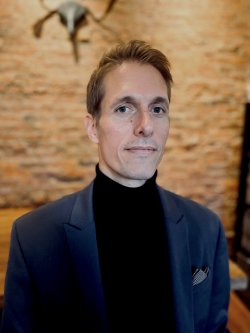
Arnaud Kurze
Associate Professor, Sociology, Criminology, and Justice Studies, College of Humanities and Social Sciences
- Office:
- Dickson Hall 352
- Email:
- kurzea@montclair.edu
- Phone:
- 973-655-7960
- Degrees:
- BA, Sciences Po, France
- MA, University of Hagen, Germany
- PhD, George Mason University
- vCard:
- Download vCard
Profile
Dr. Arnaud Kurze is Associate Professor of Justice Studies at Montclair State University. He is also the Director of Project AROS Lab, a collaboration between Montclair and US-based and international organizations to promote innovative research, experiential learning, and digital literacy. Since July 2025 he is a Senior Fellow at the Global Governance Institute in Brussels, Belgium as part of the Artificial Intelligence and Global Governance program. His scholarly work on transitional justice in the post-Arab Spring world focuses particularly on the intersection of youth activism, art, technology, and collective memory.
From 2016-2025 Dr. Kurze was a Global Fellow at the Woodrow Wilson Center in Washington, DC studying youth resilience in North Africa and the Middle East. He has published widely in academic journals, contributed to edited volumes and is author of several reports on foreign affairs for government and international organizations.
Dr. Kurze is the co-author of "Mapping Queerness in Times of Uncertainty" (2025), "Justicecraft: Imagining Justice in Times of Conflict" (2024) and of "Mapping Global Justice: Perspectives, Cases and Practice" (2022). He is also the co-editor of the book, "New Critical Spaces in Transitional Justice: Gender, Art & Memory" (2019). He has given many interviews on a variety of topics, including bridging the gap between theory and practice on global justice, the politics of collective memory in US society and beyond, LGBT issues in the Middle East and Tunisia’s democratization process, among others. He has been the recipient of many awards and fellowships, including the Library of Congress and Fulbright.
Specialization
Transitional Justice, Social Movements and Human Rights
Resume/CV
Links
Montclair State University does not endorse the views or opinions expressed in a faculty member's webpage or website. Consistent with the principles of academic freedom, the content provided is that of the author and does not express the opinions or views of Montclair State University.
- Schedule Appointment via Navigate (NEST)
- Project AROS Lab
- Book on Mapping Global Justice: Perspectives, Cases and Practice
- Interview on Mapping Global Justice: Perspectives, Cases and Practice
- Book on Transitional Justice, Gender, Art & Memory
- Interview on Transitional Justice, Gender, Art & Memory
- Personal Webpage
- Interview on democratization process in Tunisia
- Wilson Center Fellow
- Interview on LGBT issues in the Middle East
- Scholarship and Creative Works @ Digital Commons
Documents
- Guest Lecture on "Propaganda, War Crimes Trials and International Law" Mar 7, 2019 @1:00 PM
- New Spring 2017 Course on Human Rights and Int'l Justice JUST 389-04
- Guest Lecture on Nationhood and Identity on April 25, 2016 @ 4:00 pm
- Workshop on "Digital Humanities" Sept 23-24, 2015 @9:00 am
- Roundtable Discussion on "Egypt in Transition" April 15, 2015 @ 11:30 am
- Film Screening "Seeking Truth in the Balkans" Mar 16, 2015 @ 11:30 am
- Guest Lecture on US-Iranian Relations Feb 23, 2015 @ 11:30 am
- Guest Lecture on "Human Rights, Justice & Democracy in the Arab Spring," Oct 27, 2014 @5:30 PM
- Roundtable on Human Rights and Youth Activism on Nov 15, 2016 @ 1:00 pm
Research Projects
Youth, Art & Resilience
SEEKING ALTERNATIVE JUSTICE AMID POLITICAL CHANGE
This research project focuses on youth and injustice, more precisely on how and why the former deal with the latter. Its originality lies in looking at some of the old problems from a new perspective by zooming in on art-inspired contentious politics and exploring the concept of resilience particularly in contexts that impede direct forms of resistance or civil disobedience. Regime changes, particularly non-violent transformations, have spilled much ink in the past. In recent years political transitions have increasingly been studied from a transitional justice lens to shed new light on past wrongdoings, focusing on accountability issues and memory politics. Scholarship has often relied on state-centric analysis — put differently, how governments deal with the past — bottom-up studies, which put the accent on civil society, have also found growing attention within the literature. Marginalized or voiceless actors, however, have been mostly ignored in scholarship. And in spite of state-driven initiatives to deal with the past, societies often encounter difficulties coping with the aftermath of atrocities and oppression, including challenges associated with properly accounting for past wrongdoings or recognizing the burden faced by victims of political and conflict-related violence. Youth, Art & Resilience taps into these persistent issues, notably homing in on vulnerable and sidelined actors, such as youth.
While the mediatization of the Arab Spring brought youth centerstage, they have been actively engaged in transition processes in the past. Unfortunately, little is known about the increasing engagement and advocacy of youth in these transitional contexts. Instead, when inquiring about the role of youth during these processes many questions remain unanswered until now. Some of the questions that can be raised in this context include: Who are these young activists? How and why have they risen? And why have they often been marginalized by the political mainstream? Finding answers to these questions requires examining the expansion of globalized advocacy networks and the spread of social media, which reduced geographical boundaries with the help of information technology. The project aims at understanding this transnational interconnectedness against the backdrop of a selection of case studies of current youth dealing with past human rights abuses, war crimes and other social injustice. It illustrates how youth activists’ goals differ greatly from some of the objectives laid out by more conventional measures implemented after mass atrocities and the fall of repressive and dictatorial regimes. Domestic and international war crimes trials, for instance, serve the purpose of establishing accountability. Yet, the politics of justice, resulting in enormous caseloads that cannot be processed in a timely manner and the conundrum of selecting symbolic and significant cases to advance criminal law, has left victims’ groups with a sense of disempowerment and disenfranchisement. Truth commissions, as part of restorative justice practices, are also problematic in spite of promising ideals to serve those most affected by trauma.
Youth activism therefore emerged as a response, seeking alternative forms of addressing apparent injustices. Strategies of youth in their collective action repertoire include street art, performance activism and social media campaigns, among others. Contrary to some of the established transitional justice mechanisms, youth-led activities do not aim at closing the books. Instead, youth leaders advocate for a public debate and engage directly with society to confront post-conflict and post-authoritarian justice issues at the local level. The project argues that this performance-based advocacy work has fueled the creation of new forms of expression and spaces of deliberation to contest the culture of impunity and challenge the politics of memory in different transitional contexts. The project provides two sets of answers. First, it offers a contextual background to understand these new, alternative transitional justice practices. Second, it provides a conceptual framework that links youth, art and resilience, followed by a number of case studies to illustrate this complex phenomenon.
Transversal Climate Justice: A Multi-Year Research Agenda
My research sits at the intersection of transitional justice, global governance, and climate justice, examining how communities, civil society actors, and institutions respond to injustice amid compounding political, social, and environmental pressures. This work is anchored in the Justicecraft framework — an analytical lens I have developed over the past decade for understanding how justice is practiced, contested, and reshaped from below.
A central strand of this agenda advances what my co-author Christopher K. Lamont and I call transversal climate justice: an approach that moves beyond disciplinary and transnational framings to trace how climate change connects to migration, public health, development, and human rights. Climate change is not only an environmental problem but a justice problem — its burdens fall unevenly on populations who have contributed least to its causes, and its governance is shaped by histories of inequality that cut across borders and scales.
Building on this foundation, a multi-year line of empirical research examines the gendered and intersectional dimensions of climate-related human mobility. Recent collaborative work in Progress in Disaster Science analyzes how National Adaptation Plans in Bangladesh, Ethiopia, and Fiji shape — and too often constrain — women's agency across the mobility cycle. An ongoing companion project investigates how civil society organizations across African countries operate as de facto governance actors in translating gender-sensitive adaptation commitments into practice. Together, this research reframes mobility not as a failure of adaptation but as a potentially transformative risk-management strategy, provided governance systems expand rather than restrict the capabilities of those most exposed to climate risk.
Alongside this climate-justice agenda, I continue to work on youth-led, art-based activism as a site where new justice claims emerge — a subject developed in my book manuscript under review with a major University Press, "Alternative Justice." I direct Project AROS Lab (PAL) at Montclair State University, where undergraduate researchers are integrated into this broader program, and I hold affiliations with the Global Governance Institute in Brussels, NYU, and Columbia.