
View Profile Page
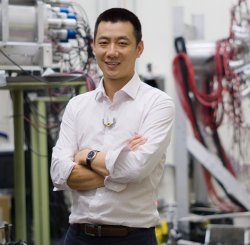
Kent Leung
Assistant Professor, Physics and Astronomy, College of Science and Mathematics
- Office:
- Richardson Hall 269A
- Email:
- leungk@montclair.edu
- vCard:
- Download vCard
Profile
STUDENT DROP-IN HOURS in my office (Richardson 269A):
Tue May 31, 3:30pm - 5pm
Thu Apr 02, 3:30pm - 5pm
Tue Apr 07, 3:30pm - 5pm
Thu Apr 09, 3:30pm - 5pm
Tue Apr 14, (no session!)
Thu Apr 16, 3:30pm - 5pm
Fri Apr 17, 3:30pm - 5pm (make up)
Tue Apr 21, 3:30pm - 5pm
Thu Apr 23, 3:30pm - 5pm
Tue Apr 28, 3:30pm - 5pm
Thu Apr 30, 3:30pm - 5pm
Work phone (VoIP call or text): +1 (973)604-9626
Do not hesitate to reach out if I'm supposed to be in my office or if the door into the RICH 269 office suite is locked.
Assistant Professor of Physics, Montclair State University (2021-current)
Affiliated-Faculty in Experimental Nuclear Physics Group, NCSU, Raleigh, NC (2021-current)
Research Assistant Professor of Physics, Duke University, Durham, NC (2020-2021)
Research Assistant Professor of Physics, North Carolina State University, Raleigh, NC (2017-2020)
Post-doc: North Carolina State University, Raleigh, NC (2013-2017)
Doctor of Natural Science: Technical University of Munich, Germany (2007-2013)
Doctoral research fellowship: Institute Laue-Langevin, Grenoble, France (2007-2011)
B.S. & M.S.: University of Auckland, New Zealand (2005 & 2007)
Montclair State Experimental Nuclear Physics research group website:
https://montclairstatenuclear.wordpress.com/
Maintained list of publications: https://scholar.google.com/citations?user=_pf63jQAAAAJ
CV at the bottom of page.
My research interests are in nuclear physics, fundamental symmetries, and searches for Beyond Standard Model physics. I am particularly interested in low-energy, high-precision experiments, performed at low-temperatures involving neutrons. These experiments allow us to address fundamental questions, such as:
- How was more normal matter than anti-matter generated during the Big Bang?
- Are there undiscovered forces or particles out there, and could these explain the missing Dark Matter?
- What are the symmetries of our physical laws? Why are some violated, some conserved, and some extremely fine-tuned?
- How did the primordial light elements form during the Big Bang?
- How do protons, neutrons, and quarks interact to form nuclei?
In order to push our experiments to the next-level of precision, we constantly implement and develop cutting-edge technologies. The interdisciplinary techniques I'm interested in are, for example, cryogenic devices and apparatuses involving superconductors and superfluid helium at milli-Kelvin temperatures, quantum sensors for magnetic and electric fields, nuclear magnetic resonance with hyper-polarized gases and solids, scintillation and fluorescence radiation detection, synthesis of high-purity deuterated polymers and coatings, and surface morphology and properties measurements.
I am a first-generation university student, born to asylum-seeking parents from Hong Kong who later immigrated to New Zealand, where I grew up. My passion for physics was sparked in my final year of high school after reading "A Brief History of Time" by Stephen Hawking, at a time when I was still uncertain about attending university. That experience taught me how reading and extracurricular exploration can open doors, foster deep connections across ideas, and ignite lasting interests.
Coming from a working-class background, I spent my summers operating manufacturing machines and driving forklifts—experiences that continue to shape my perspective on physics. For me, physics is everywhere: it enriches daily life if you know where, and how, to look. In the classroom, I strive to connect abstract principles to everyday experiences, showing students that physics is not obscure or esoteric but an active force in the world around us.
Physics is a key driver of current and future technologies, and it provides the deep insights for a wide range of fields. At the same time, history has shown us that fundamental research—-often pursued decades before actual applications are realized—-is required to plant the seeds for transformative understanding. I believe a balanced investment in both short-term applications and long-term foundational research best serves the advancement of science and society.
Resume/CV
Links
Montclair State University does not endorse the views or opinions expressed in a faculty member's webpage or website. Consistent with the principles of academic freedom, the content provided is that of the author and does not express the opinions or views of Montclair State University.
- Maintained list of my publications (Google Scholar)
- NC State University Profile Page
- The neutron Electric Dipole Moment at Oak Ridge National Laboratory Collaboration webpage
- Triangle University Nuclear Laboratory in North Carolina website
- PBS outreach article
- Explore my research at Research with Montclair
- Explore my research at Research with New Jersey
- Scholarship and Creative Works @ Digital Commons