
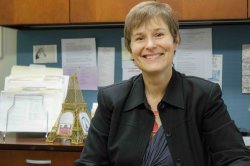
Elizabeth N Emery

Faculty/Staff Login:

Professor, Modern Languages and Literatures

Office:
Schmitt Hall 241J
E-Mail:
Phone:
973 655-4452
Fax:
Not Available
Degree(s):
BA:Wellesley College
MA:New York University
MPhi:New York University
PhD:New York University
vCard:
Download vCard File

Profile

Welcome to the French Program at Montclair State!

I’m happy to respond to all inquiries about the MA in French Studies, the MA in French Literature, or Instructional Certification in French. In fact, feel free to contact me about anything related to French! We have many exciting activities occurring through the year, from film nights, making crêpes, discussing career opportunities in French, and speaking French on the immersion floor of The Heights to dining in French restaurants and going on cultural excursions to New York, Québec, and Nice.

Specialization

Medieval and nineteenth-century French literature and cultural studies. The reception of medieval art, architecture, and literature in nineteenth and twentieth-century Europe and America. Early photojournalism, celebrity interviews, European and American writer house museums, Naturalism, Decadence, mysticism, cabaret culture, nineteenth-century French theater. Global food politics and sustainability studies.

Resume/CV


Office Hours

Fall

  • Monday 12:00 pm - 1:00 pm
  • Monday 2:30 pm - 3:30 pm
  • Monday 5:15 pm - 5:45 pm
  • Thursday 3:30 pm - 4:00 pm

Spring

  • Monday 2:30 pm - 4:30 pm
  • Wednesday 4:45 pm - 5:45 pm

Links


Research Projects

Photojournalism and the Origins of the French Writer House Museum (Ashgate Publishing, 2012)

Why did writers' private homes become so linked to their work that contemporaries began preserving them as museums? Photojournalism and the Origins of the French Writer House Museum addresses this and other questions by providing an overview of the social forces that brought writers' homes to the forefront of the French imagination at the end of the nineteenth century and the beginning of the twentieth. This study analyzes representations of the apartments and houses of Corneille, Hugo, Balzac, Dumas, Sand, Zola, Loti, Montesquiou, Mallarme, and Proust, among others, arguing that the writer's home became a contested space and an important part of the French patrimony at this time. This is the first book to emphasize the house museum as an essentially modern construct, and to trace the history of ideas leading to its institutionalization in twentieth-century France. The interdisciplinary study also brings new attention to the importance of photojournalism for fin-de-siecle France and brings to light fascinating and forgotten examples of "at home" photography by Dornac and Henri Mairet, neither of whom are commonly included on lists of active nineteenth-century photographers.

Martyr to the Truth: The Autobiography of Joseph Turmel

In his autobiography Joseph Turmel (1859-1943) has left an intensely personal account of his struggles to reconcile his Catholic faith with the results of historical-critical methods as those impacted biblical exegesis and the history of dogma. Having lost his faith in 1886, he chose to remain as a priest in the Church, even while he worked to undermine its teachings. He did so initially in writings published under his own name and, as his conclusions became increasingly radical, under a veritable team of pseudonyms. He was excommunicated in 1930. His account of his life is less a discussion and defense of his ideas than it is a moral justification of his conduct. Turmel is associated with the left wing of Roman Catholic Modernism along with Albert Houtin, Marcel Hébert, and Félix Sartiaux. Translated with C.J.T. Talar.

The Modernist as Philosopher. Selected Writings of Marcel Hebert.

Translated with C.J.T. Talar (Catholic University of America Press, 2011).

Makers of the Middle Ages: Essays in Honor of William C. Calin (Studies in Medievalism, 2011)

The twenty well-known scholars featured in this Festschrift for William Calin engage in personal reflection about the ways scholars, writers, musicians, and artists from different periods have "made" the Middle Ages by exploring it in their own work. Contributors: Barbara K. Altman, Pam Clements, Elizabeth Emery, Karl Fugelso, Caroline Jewers, Alicia C. Montoya, Gwendolyn A. Morgan, E.L. Risden, Nils Holger Petersen, William D. Paden, F. Regina Psaki, Carol L. Robinson, Roy Rosenstein, Tom Shippey, Jesse G. Swan, M.J. Toswell, Richard Utz, Kathleen Verduin, Veronica Ortenberg West-Harling, Gayle Zachmann

Consuming the Past: The Medieval Revival in Fin-de-siècle France

From pilgrimages to popular festivals, from modern spectacles to advertising, from the work of avant-garde painters to the novels of Emile Zola, Consuming the Past explores the complexity of the fin-de-siècle French fascination with the Middle Ages. The authors map the cultural history of the period from the end of the Franco-Prussian war to the 1905 separation of Church and State illuminating the powerful appeal that the medieval past held for a society undergoing the rapid changes of industrialisation. Challenging the prevailing notion that this was a mere passing fashion seized upon by the tourist industry and the manufacturers of cards and bibelots, the authors argue that popular and scholarly interest evolved together and strongly influenced the emergence of fresh ideas about French identity, art, history and religion.

Romancing the Cathedral: Gothic Architecture in Fin-de-Siècle French Culture

Through an analysis of political, art historical, and literary discourse, this book considers French fascination with the Gothic cathedral. Romancing the Cathedral explores the late-nineteenth-century French passion for Gothic architecture, particularly the cathedral. Though maligned in the seventeenth and eighteenth centuries and vandalized during the French Revolution, by World War I the cathedral was considered "the genius of the French nation," a privileged and patriotic work of art that surpassed such other national artworks as Wagner's operas and the Parthenon. However, the moment at which the Gothic style finally reached near-universal acclaim in France also coincided with one of the most anti-clerical periods of French history, the years surrounding the separation of church and state. Taking this contradiction as a starting point, Elizabeth Emery explores how the cathedral's popularity stemmed from its semantic richness as well as its glorification in the works of such writers and artists as Emile Zola, J.-K. Huysmans, Marcel Proust, Paul Claudel, Claude Monet, Auguste Rodin, and others. Using their works as a springboard, Emery examines the ways in which they responded and contributed to prevailing discourses about the cathedral. Interdisciplinary in nature, Romancing the Cathedral will appeal to those interested in Gothic art and architecture, European cultural studies, medievalism, and French literature.