Día de los muertos: De la memoria a la tradición
Death is something inevitably shared by all of us; to celebrate it, to talk about it, and to laugh together in spite of fear allows us to grow and embrace the duality of life. For this reason, celebrations such as the Day of the Dead- present across different cultures and countries -offer us a space to, as a community, feel, share memories, and recognize that the love for those who have passed always remains, even if it changes form.
We remember them with joy, with sorrow, with affection; with their favorite foods and drinks.
We remember them in every face of those who are still here, in every trace they left behind, in every lesson they taught us.
We remember them when we speak to them, when we feel them, when we love them; when we give ourselves the space to live through whatever emotion arises.
We remember them once more, because in the rhythm of daily life we may forget that, although they are no longer here as before, they are still present.
Indigenous Peoples have a different appreciation of death: first, they recognize it as a natural part of life; second, they celebrate it and welcome it; and third, they laugh at it. All this with the intention of seeing it as it truly is, death, nothing more. Without the mind’s added layers, without attachment to the material state of existence.
On Monday, November 3rd, during an intimate and special autumn afternoon, we gathered in community – students, professors, and staff from Montclair State University; leaders and members of the Indigenous communities of Mexico and Ecuador; and students from the Kichwa Language and Culture course, their instructor and Kichwa community leader, Atik Paguay, his family, to take part in this event called: Dia de los muertos: from memory to tradition”.
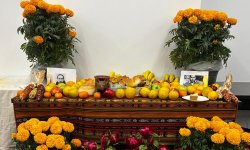
On this occasion, we built together the temple for our beloved departed, with yellow and orange flowers; we placed their photos, offered their favorite fruits, and each person shared an intention or a personal message for their loved ones.
We learned about calaveritas, that poetic form that turns our fears into humor and allows us to celebrate life. The session was guided by the Mexican Indigenous artist Marco Nieto, who invited us to laugh at death through words and creativity.
We invited death – the calaca, the huesuda, as our Mexican brothers and sisters call her -; we wrote her a poem, laughed at her, and drew her closer to us, normalizing what is still considered taboo or superstition. In doing so, we softened with joy what once caused us fear.
Verónica Muenala, a Kichwa Otavalo leader and member of the Pueblos Originarios group, prepared the “colada morada” for us, offering much more than a drink. During the Spanish conquest, the Indigenous peoples of Ecuador created it as a symbol of resistance, honor, and connection with their departed loved ones.
This beverage, made with purple corn representing life, and mortiño (andean blueberry), which connects us with the departed, along with guaguas de pan, gives us a symbolic means to talk to them.
We had the opportunity to form a circle and shout in harmony, “Wantiya.” As Atik Paguay explained, it is an energetic cry that people traditionally use so that the energies of the deceased may be welcomed into the natural environment.
Finally, Mije leader, Próspero Martínez shared his live music, filling the space with his guitar, songs, and energy. His presence reminded us that traditions are also sound, body, and community.
All these different Day of the Dead traditions, together, achieve the same purpose: an encounter with those who have passed on to another state, unknown, yet close. A place where the material body ceases to exist, but energy continues its journey through the vast universe of which we are all a part.
We thank the Council of Indigenous Peoples and the Latin American Indigenous Collaborative (LAIC) of CLaSE for organizing an event that allowed us to reconnect with our loved ones. We honored them as a community and perceived death as a state of energetic transformation.
The emotions and thoughts this event evoked in me were deeply tied to the familiarity of these traditions, to my Ecuadorian culture, and to the recent memory of my grandfather, who passed away a few months ago. It offered me a perspective of celebration that doesn’t necessarily need to be sad, but rather colorful, energetic, and full of hope.
Wantiya to all our loved ones, may the energetic cry have been felt, and may your energy have been embraced by nature.
Written by: Micaela Pesantez Rodriguez – Graduate Students and HOLA fellow.
En español:
La muerte es algo inevitablemente común a todos nosotros; celebrarla, conversar sobre ella y reírnos juntos, a pesar del miedo, nos permite crecer y abrazar la dualidad de la vida. Por eso, celebraciones como el Día de los Muertos, presentes en distintas culturas y países, nos conceden este espacio para que, en comunidad, nos permitamos sentir, compartir memorias y reconocer que el amor hacia nuestros difuntos siempre permanece, aunque cambie de forma.
Los recordamos con alegría, con pena, con cariño; con sus comidas y bebidas favoritas de las personas queridas que ya dejaron este mundo.
Los recordamos en cada rostro de quienes siguen aquí, en cada huella que dejaron, en cada lección que nos enseñaron.
Los recordamos al hablarles, al sentirles, al amarles; al darnos el espacio para vivir cualquier emoción que surja.
Los recordamos una vez más, porque con el ritmo diario quizá olvidamos que, aunque ya no están como antes, siguen estando.
Los Pueblos Originarios tienen una apreciación distinta de la muerte: primero, la reconocen como parte natural de la vida; segundo, la celebran y le dan la bienvenida; y tercero, se ríen de ella. Todo esto con la intención de verla tal como es: muerte, nada más. Sin añadiduras de la mente, sin apego al estado material de la existencia.
El lunes 3 de noviembre, durante una íntima y especial tarde de otoño, nos reunimos en comunidad: estudiantes, profesores y administrativos de la Universidad de Montclair; líderes y miembros de las comunidades indígenas de México y Ecuador; los estudiantes del curso de lengua y cultura Kichwa, su instructor y líder de comunidades Kichwa, Atik Paguay, su familia, para participar en el evento titulado: “Día de los Muertos: de la memoria a la tradición”.
En esta ocasión todos nosotros armamos el templo para nuestros queridos muertos, con flores amarillas y anaranjadas; colocamos sus fotos, ofrecimos sus frutas favoritas, y cada persona compartió una intención o un mensaje personal para sus seres queridos.
Aprendimos sobre las calaveritas, ese recurso poético que transforma nuestros miedos en humor y nos permite celebrar la vida. La sesión fue guiada por el poeta y artista mexicano Marco Nieto, quien nos invitó a reírnos de la muerte a través de la palabra y la creatividad.
Invitamos a la muerte – la calaca, la huesuda – como le dicen nuestros hermanos mexicanos; le escribimos una poesía, nos reímos de ella y la acercamos a nosotros, normalizando aquello que aún es tabú o superstición. Así, suavizamos con alegría lo que alguna vez nos causó temor.
Verónica Muenala, miembro de los Pueblos Originarios, nos preparó la colada morada y nos brindó algo mucho más que una bebida. Durante la conquista española, los pueblos indígenas del Ecuador la crearon como un símbolo de resistencia, honor y conexión con sus muertos.
Esta bebida, elaborada con maíz morado que representa la vida y con mortiño, que nos une con los difuntos, junto a las guaguas de pan, nos brinda un medio simbólico para conversar con ellos.
Tuvimos la oportunidad de armar un círculo y gritar en armonía “Wantiya”. Como explicó Atik Paguay, es un grito energético que la gente acostumbra mencionar para que las energías de los fallecidos sean aceptadas en el entorno de la naturaleza.
Finalmente, el líder indígena mije, Próspero Martínez, compartió su música en vivo, llenando el espacio del sonido de su guitarra, cantos y energía. Su presencia nos recordó que las tradiciones son también música, cuerpo y comunidad.
Todas estas diferentes tradiciones del Día de los Muertos, en conjunción, logran el mismo propósito: un encuentro con los que ya han pasado a otro estado, desconocido y, al mismo tiempo, cercano. Un lugar donde el cuerpo material deja de existir, pero la energía continúa su camino en el vasto universo del que todos somos parte.
Agradecemos al Consejo de los Pueblos Originarios y al Latin American Indigenous Collaborative (LAIC) de CLaSE por haber organizado un evento que nos permitió reconectar con nuestros seres queridos. Los honramos en comunidad y percibimos la muerte como un estado de transformación energética.
Las emociones y pensamientos que generó en mí este evento estuvieron profundamente ligados a la familiaridad de estas tradiciones, a mi cultura ecuatoriana y al recuerdo reciente de mi abuelo, quien partió hace unos meses. Me ofreció una perspectiva de celebración que no necesariamente necesita ser triste, sino en cambio colorida, energética y esperanzadora.
Wantiya a todos nuestros seres queridos – que el grito energético se haya sentido y que la energía de ustedes haya sido aceptada en la naturaleza.
Micaela Pesantez Rodriguez – Estudiante de graduado y miembro de HOLA