
Roots and Recipe: Learning from Indigenous Cuisine and Language
Posted in: CLaSE, Latin American Indigenous Collaborative (LAIC)
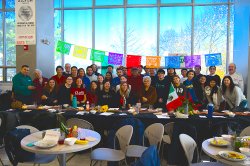
The Latin American Indigenous Collaborative (LAIC) at CLaSE closed its Fall semester programming with a warm and memorable gathering: “Roots and Recipe: Learning from Indigenous Cuisine and Language”, an event proposed by Professor Jerise Fogel as part of series she carries on through the academic year called “In Search of the Green World: Global Indigenous Cultures, the Human Imagination, and Environmental Justice” (greenworld.jerise.com). The event was sponsored by the Spanish and Latino Studies department, and MASA (Mexican American Student Association) and brought together students, faculty, and staff to explore the deep connections between food, culture, and identity through the work of Mexican chef Irwin Sánchez.
A Lesson in Language and Ancestry
Chef Sánchez guided participants not only through a culinary tradition, but also through the sounds and stories of Nahuatl, the Indigenous language he inherited from his grandfather. Several of his poems, written in Nahuatl, served as the linguistic centerpiece of the event.
While Sánchez cooked, attendees in the adjacent space learned Nahuatl vocabulary through interactive games and presentations designed by members of CLaSE and MASA. Through scavenger hunts, word searches, and a presentation by Abraham De Jesús and Jonas Cruz-Morales (MASA), participants discovered how widely Nahuatl still resonates today, including in familiar English words such as chocolate, avocado, and chile. They also learned that Nahuatl continues to be spoken across communities in Puebla, the region surrounding Mexico City, and the states of Guerrero and Veracruz.
Cooking Milpa Soup, Sharing Knowledge
In the Teaching & Learning Kitchen at the Freeman Dining Hall, Sánchez prepared Milpa soup, a seasonal dish traditional to Indigenous communities from the Puebla region. Joined by 15–16 students and faculty “co-chefs,” he shared anecdotes, cultural insights, and culinary secrets, turning the kitchen into a vibrant space of storytelling and discovery.
His knowledge, generosity, and lively personality filled the room. As he chopped, stirred, and seasoned, he described the significance of each ingredient, from Indigenous herbs and spices to the special Mexican salt he brought with him, essential to the flavors of his cuisine. Once the cooking session concluded, the Freeman Dining Hall staff served the Milpa soup. Everyone gathered at one long table to enjoy the rich flavors and shared experience, transforming lunch into a moment of community.
An Intergenerational Journey
Over the meal, Sánchez recounted his personal journey: how his grandfather taught him Nahuatl, how he built a life and community in Freehold after arriving in the U.S., and how the passing of his grandfather and the birth of his son sparked a renewed commitment to reclaiming the Nahuatl language.
His son represented the future, his grandfather the past and Nahuatl, their shared language, became the bridge between them. “But something was still missing,” he reflected. “It wasn’t until I began cooking again, reconnecting with the flavors of home, the ingredients that tasted different here, that I realized that food was the final piece. Using Indigenous ingredients, herbs, and spices completed me.”
Chef Sánchez emphasized that returning to one’s roots is always possible. “Forgetting your language,” he told the audience, “is like breaking the mirror where you see yourself.” His message deeply resonated with many of the Latino/Hispanic students present, who saw in his story both inspiration and encouragement to preserve their own heritage languages and cultural traditions.
A Poetic Ending
The event concluded with a reading of one of Sánchez’s poems in Nahuatl, followed by its English translation, a moment that left the audience in quiet awe.
Jennifer Bostedo, Director of Dining and Wellness at Freeman Hall, reflected on the evening’s success:
“Gourmet Dining is delighted to collaborate with our campus community to create culinary experiences that build awareness of global cuisines and food issues, expand the palate, and celebrate the cultures that connect us. Our Teaching Kitchen becomes a space where students and staff can share, grow, and learn through programming that honors our students’ cultural heritages. Traditional foodways offer not only flavor and aroma, but even poetry in Indigenous Nahuatl. We are deeply grateful to chef Irwin, CLaSE and Dr. Calarota-Ninman, MASA, the Department of Spanish and Latino Studies, Professor Fogel, and the entire community for this vibrant feast.”
At the close of the event, Bostedo announced that her team plans to submit this event to the North American College and University Food Service Association (NACUFS) for consideration in next year’s awards cycle. Winners are typically selected in June, and, as she added with enthusiasm, “I would be truly surprised if our combined efforts, and Chef Irwin’s incredible talent, don’t receive recognition in one of the categories.”
Jonas Cruz-Morlaes, President of the Mexican-American Student Association (MASA) reflected on the successful event.
“MASA was truly honored to take part in this meaningful cultural event and to collaborate with CLaSE, the Gourmet Dining staff, and chef Irwin Sánchez. As an organization whose mission it is to promote Mexican cultural awareness, traditions, and representation on campus, opportunities like these enable us to carry out our mission in a powerful and tangible way. The possibility of sharing fragments of our heritage through our language, foodways, and stories brings a sense of belonging to the student community, while reminding many of us of home.
We are incredibly thankful that so many campus offices understand the importance of celebrating culture and heritage and continue to create spaces where student voices and lived experiences are valued. It is through partnerships like this one that we are able to bring visibility to indigenous languages such as Nahuatl and Zapoteco, highlight the richness of Mexican culinary traditions, and faster cross-cultural learning among students, faculty, and staff.
For MASA and myself, this event was more than a collaboration, it was a reminder that our roots lie in resilience and beauty. Watching students and faculty learn about Nahuatl, taste the Milpa soup, and learn from Chef Irwin Sanchez’s personnel journey showed how culture and build bridges, strengthen identity, and spark pride in our origins. We look forward to continuing this work, expanding opportunities for our campus community to learn, connect, and celebrate together.”
Dr. Antonella Calarota-Ninman, director of CLaSE, concludes with her reflections: “It’s truly a blessing when students, faculty, staff, talented professionals from other communities get together to learn, to celebrate, to inspire, and to share how food, language and culture can reunite generations, can lift our souls and reinforce that bridge between past, present and future.”