
Celebrating the Voices of Montclair State’s Latino and Latina Community
Posted in: CLaSE
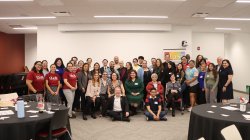
On March 31st, the Center for Latino Heritage and Spanish Language Excellence (CLaSE) came together to celebrate the vibrant presence and powerful stories of Latinos and Latinas employees at Montclair State University. This celebration was part of a project led by HOLA – Historia Oral de los Latinos y Archivo Digital, one of the key initiatives of the CLaSE, and the first Latino Oral History program at Montclair.
Below are remarks from Antonella Calarota-Ninman, Director of the Center for Latino Heritage and Spanish language Excellence, from the event.
At HOLA, students are at the heart of everything we do. In our Spanish classes, students conduct oral history interviews, while our fellows edit the recordings, create subtitles, and prepare bilingual transcripts—so the stories can be heard and read in both Spanish and English on our website.
So, what is Latino Oral History? It’s storytelling with purpose. It’s about identifying which communities we want to spotlight—giving them space, voice, and recognition. Through interviews, we listen to life experiences, honor personal journeys, and open doors for collective learning and empathy.
It’s been an incredible journey so far. We’ve gathered stories from Indigenous Latin American communities, Latino activists, and even detainees in U.S. detention centers. In our very first year, students interviewed their own family members. That project moved us deeply. We realized how many students had never heard the full story of their parents or grandparents—what they sacrificed, what they endured to be here. Alongside those emotional revelations were also stories of triumph, resilience, and achievement.
After years of reaching out beyond campus, last semester we turned our attention inward—to the very people who make Montclair State what it is. We asked: What about the Latino employees right here on campus? The staff and faculty whose roots span the beautiful range of Latin America—from North and Central America to South America and the Caribbean?
So we found them. We listened. And we learned.
On March 31st, we celebrated them. Their multiculturalism, their journeys, their identities. We honored the unique ways in which their Latino and Latina experiences enrich our university—bringing depth, perspective, creativity, and heart.
I personally listened to nearly every story collected. And what I heard was nothing short of inspiring.
I heard voices reflecting on the challenges of navigating higher education as first-generation college students—and now, they’re here mentoring the next generation, walking alongside them.
I heard stories filled with warmth and human connection—words like dialogue, understanding, sharing, encounter. And of course, the delicious taste of home was present too: encebollado, pernil, ceviche, pan de bono, una parrillada con todo.
From Johnny Lorenz, we learned how knowing another language it gives you a power, it’s a powerful agility that no one can have, unless they speak another language. He says: “You are moving between systems of thoughts, systems of feelings. It’s like a movement of the mind.” He used an analogy with soccer, that I am sure another big aficionado of soccer, like Cristian Vergara will appreciate, “knowing another language (in whatever capacity and level) it’s like a dribble that not everybody can do, but you can.
From Valeria Aloe, I learned that you can go from being the first in your family to pursue higher education to becoming a thought leader in conscious leadership, an award-winning author, and keynote speaker.
From Esperanza Brizuela-Garcia, I learned that you can live for years in another continent, without speaking Spanish—and yet still ache for your language and culture, because it lives in your veins and rests in your heart.
And from our Provost, I learned that we are all a mosaic of identities. That you can be a trained physician, psychiatrist, and researcher, and still shift paths—becoming a provost, a university president, a visionary. If you have purpose, and you believe in your vision—you can make it happen.
That day, the room radiated with joy, pride, and community. There was a shared sense of belonging, laughter, energy, and real celebration. One attendee said it best:
“I had goosebumps listening to what other people said and left the room feeling proud and happy to be Latina. Heads up and empowered.”
Another attendee told us the day after the event: “I went from sitting at a dinner, the night before, with international faculty, where the conversations were filled with anxiety and uncertainty about immigration and the future—leaving me feeling like I wanted to hide—to Monday night event filled with pride, wanting to shout my Venezuelan identity from the rooftops. For the first time in a while, I felt good again about where I come from.”
We couldn’t ask for more.
Who are we? We are a team of five professors from different departments and colleges: Raul Galoppe (Spanish and Latino Studies), Fernando Naiditch (Teaching and Learning), Anne Edstrom (Spanish and Latino Studies), Stephen Ruszczyk (Sociology), and myself. We are also proud to work alongside two exceptional HOLA fellows: Mica Pesantez and Crystal Tejada-Breton.