Mushuk Nina: The New Fire, A Living Continuity
Posted in: CLaSE, Latin American Indigenous Collaborative (LAIC)
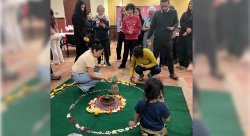
On March 23, 2026, Montclair State University was transformed into a space where time seemed to fold, where ancient rhythms met the present, and where fire, earth, and memory spoke together. Under the leadership of Antonella Calarota-Ninman, the Latin American Indigenous Collaborative (LAIC) at CLaSE presented the celebration of Mushuk Nina, the “new fire,” inviting all who gathered into the living heart of Pawkar Raymi, one of the most profound seasonal celebrations of Andean peoples.
Rooted in the spring equinox, when light and darkness stand in quiet balance, this is a time of blossoming, of opening, and of return- to the earth, to memory, and to the cycles that sustain life. Because nature does not only renew itself; it teaches us how to renew ourselves with it.
At the center of this renewal is the fire itself. Mushuk Nina carries the promise of beginning again, of cleansing what has been lived and transforming what we carry within. It reminds us that within each of us exists a fire capable of renewing, healing, and reweaving the bonds that unite us as a community.
Guided by Kichwa language and culture instructor Atik Paguay and Ecuadorian artist Raúl Ayala, the gathering unfolded as a shared act of creation. Students, faculty, families, the full board of the newly formed Ecuadorian Student Association (ESA), and community members from beyond campus came together. A churu slowly emerged, built collectively, each element placed with intention, each gesture part of something larger than itself.
“La palabra tiene poder, como el fuego… transforma desde el interior.”, says Atik Paguay
Through murals, community projects, and large-scale painted panels, Raúl Ayala offered another reflection:
“This celebration is an ancestral technology… a way of thinking through our earth, our knowledge, and our memory.”
In that moment, it became clear that we were not simply observing a tradition, we were participating in it. We were sustaining its continuity.
Experiences like this allow us to connect as a community, to share what is personal, and to understand that knowledge can also be learned through the land, through traditions, and through living alongside others.
Alondra Molina and Paula Cevallos, students and co-founders of the newly born Ecuadorian Student Association (ESA) whose presence extended this moment beyond the circle in which it was created, express their feelings and observations below. Their participation symbolizes a commitment to carrying forward their roots, bridging memory and future through lived experience.
Student Reflections from ESA Co-Founders – Alondra Molina and Paula Cevallos
With this event, we learned that “Everything that burns can also be reborn.”
Fire does not only serve to illuminate, it also has the power to transform. It reminds us that even among ashes there is always the possibility of a new beginning.
This gathering leaves us with a clear sense of identity and responsibility. It invites us to recognize our roots, to value where we come from, and to understand that Indigenous culture is not only alive, but present and evolving. At the same time, it calls on us to honor it, sustain it, and create space for it. Not only in moments of celebration, but in our daily actions and decisions within the community.
This way, the experience of Mushuk Nina transcends the moment itself, becoming a seed that inspires us to cultivate a deeper connection with the land and with one another. It affirms a shared responsibility toward the environments we inhabit and the histories we carry forward.
All the members of ESA present at the event were not simply observing, we were sustaining “continuity.”
With the new fire now lit, ESA extends its sincere gratitude to CLaSE and the Latin American Indigenous Collaborative (LAIC) for making this transformative gathering possible, and remains committed to continued collaboration so that the university community may keep learning from and honoring these essential celebrations.