
Empowering Communities Through Sound: The NJ Hearing Aid Project at Montclair State University
How a strategic state partnership fosters student growth and enhances hearing health for New Jersey residents in need
Posted in: Admissions, Alumni, Audiology, College for Community Health, University
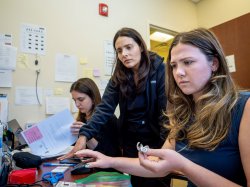
Receiving free hearing aids is life-changing not just for the New Jersey residents who are hard of hearing but for Montclair State University’s Audiology students who help refurbish and distribute them as part of New Jersey Hearing Aid Project (NJHAP).
“The most rewarding part of working for NJHAP is the knowledge that I am making a true difference in the lives of the patients we work with,” says first-year audiology doctoral student Julianna Mijal.
Second-year audiology student Emma Simas agrees: “You feel nearly as much joy as they do when it’s their turn to get hearing aids. I am always incredibly grateful when they give us a call or send an email or letter and tell us all the new things they are hearing and experiencing with their new hearing aids.”
As students in the only Doctor of Audiology program in the state, Mijal and Simas are responsible for refurbishing donated hearing aids and working with a network of audiologists across the state to distribute them to people with hearing difficulty who may not receive hearing healthcare services otherwise. With oversight from Audiology Clinical Preceptor Elena Kagan-Weitz, they oversee the New Jersey Hearing Aid Project (NJHAP), which is housed in Montclair’s Communication Sciences and Disorders program. The project is a partnership with the state’s Division of Deaf and Hard of Hearing.
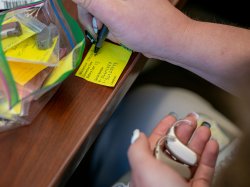
“Working with NJHAP has been an excellent lesson in humility and humanity,” says Mijal. “Connecting with patients human-to-human and understanding the multifaceted lives that they lead outside of our clinic is key in making them feel seen and heard, which leads to the best care outcomes.”
“The hearing aid project is way bigger than us. I’m so incredibly proud to be part of this project, this community and so intertwined in audiology and hearing aid fitting and selection.” ~ Emma Simas
Kagan-Weitz, who serves as principal investigator and director of the NJHAP, says that in addition to providing people in need with hearing care, it provides audiology students an opportunity to learn new skills. “All of our students have worked directly with NJHAP patients in providing them with audiological care, which incorporates our program’s exceptional education with community outreach for underserved populations.”
The mission: hearing health as social justice
The Audiology program is part of Montclair’s College for Community Health, which operates on the principle that “health is a cornerstone of social justice.” For many low-income seniors and individuals with hearing disabilities, the high cost of hearing aids – which can run as high as $7,000 and are not covered by Medicare – can impede them from navigating life.
Elizabeth Hill, director of the NJ Division of Deaf and Hard of Hearing, a part of New Jersey’s Department of Human Services says hearing aids are often “the third most expensive purchase a person might make, after a house and a car.” In addition, she adds that “one of the biggest barriers that individuals who are deaf and hard of hearing face is access to hearing health care… our mandate is to eliminate barriers to participate in society where people live and work and interact.”
Hill says that the partnership with Montclair is essential for the program’s success: “We are one of the most comprehensive hearing aid programs in the country. We are very grateful for the partnership.”
How the partnership works: a cycle of giving
Montclair State University serves as the operational hub for the NJHAP, which started in 2013, and operates as a student-led “hearing aid bank” that provides hearing devices to recipients. It works because of:
- Donations: The program relies on public donations of used hearing aids to maintain its inventory. Donors are encouraged to mail their devices to New Jersey Hearing Aid Project, Montclair State University, 1515 Broad Street, Bldg. B, Bloomfield, NJ 07003.
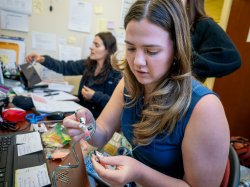
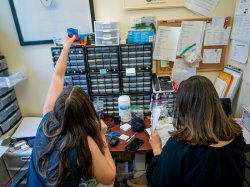
- Refurbishment: Under Kagan-Weitz’s supervision, Montclair students work in a state-of-the-art lab to refurbish these devices. If devices cannot be refurbished at the University they are sent to outside hearing aid laboratories.
- Distribution: In collaboration with participating audiology clinics and a Montclair mobile audiologist serving 14 counties, the hearing aids are custom-fitted and provided free of charge to eligible NJ residents aged 65+ or those on Social Security Disability Income who have hearing loss.
A learning opportunity for current, prospective students
For audiology students, the NJHAP offers experience that blends professional training with community impact. Second-year audiology student Emma Simas says Montclair has helped almost 100 people get hearing aids and other assistive listening devices in the past year, and there is currently a six-month wait list.
Career Readiness: Students gain hands-on experience. Kagan-Weitz says the audiology doctoral students work together to manage the daily operations of the NJHAP. Selected for their qualifications, she says, the students are “professional, consistently kind and highly collaborative, with a genuine willingness to support others.”
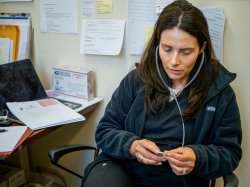
Simas adds: “The Hearing Aid Project has kept me hands-on since Day One. I’ve had early exposure to all the hearing aid brands, manufacturers and history of the technology and how far it’s come.”
Lessons in Client Care: Audiology students provide client care in real time. Simas says she’s learned to manage the expectations of patients and work to establish realistic goals and meet families where they are in the process. “Many of the individuals who participate in NJHAP are faced with a myriad of barriers, many of which involve social stigmas and systems that work against them,” adds Mijal.
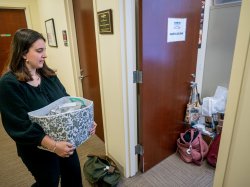
Real-World Impact: Montclair students see the direct result of their work as these devices are distributed to those in need. Simas says: “You talk to some of these patients or their families and you build connections with them. This year, the New Jersey Speech-Language and Hearing Association helped us fundraise for hearing aid supplies and made decorative bags for our patients so that we can dispense with their hearing aids with cleaning cloths, hearing aid brushes, battery cases and other tools to keep their hearing aids in the best shape. Being part of these two communities and seeing the combined impact is so heartwarming.”
Are you ready to make an impact?
Apply to the only Doctor of Audiology program in New Jersey and turn newfound clinical excellence into community action.