
View Profile Page
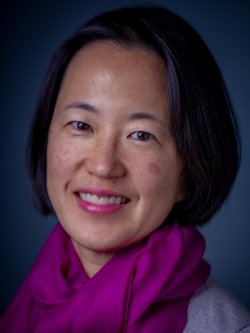
Mika Munakata
Professor, Mathematics, College of Science and Mathematics
- Office:
- Center for Computing and Information Science 425H
- Email:
- munakatam@montclair.edu
- Phone:
- 973-655-7256
- Degrees:
- BA, Pomona College
- MA, Teachers College, Columbia University
- MS, Teachers College, Columbia University
- PhD, Columbia University
- vCard:
- Download vCard
Profile
I began my career as a middle school and high school mathematics teacher. My work now at the collegiate level has direct connections to my experiences teaching at the secondary level. I typically teach methods (of teaching) courses for undergraduate students preparing to be teachers, content courses for inservice teachers at the master's level, and research courses for doctoral students. I work closely with K-12 school districts to try to bring innovative programs to K-12 science and mathematics teaching and learning. I am also involved in projects related to STEM education at the undergraduate level.
For more information about our undergraduate and graduate mathematics education programs, including our Teaching Middle Grades Mathematics programs, please see the Links section below.
Specialization
*science-mathematics connections, especially as they relate to interdisciplinary teaching and learning
*the impact of professional development programs on science and mathematics teachers
*teacher leadership
*undergraduate STEM education
Resume/CV
Office Hours
Fall
- Sunday
- 12:00 am - 12:00 am
- Please note that I will be on sabbatical Fall 2026
Links
Montclair State University does not endorse the views or opinions expressed in a faculty member's webpage or website. Consistent with the principles of academic freedom, the content provided is that of the author and does not express the opinions or views of Montclair State University.
Research Projects
Creative Thinking through Mathematics: A Student's Guide to Mathematical Explorations
My colleague, Dr. Eliza Leszczynski, and I recently published a textbook for undergraduate mathematics courses. The book guides students as they explore mathematics through creativity. It is based on an NSF-funded project, “Engaged Learning through Creativity in Mathematics and Science,” NSF Award #1611876.
Munakata, M. & Leszczynski, E. (2026). Creative Thinking through Mathematics: A Student’s Guide to Mathematical Explorations. Routledge. https://doi.org/10.4324/9781003541097
Wipro Science Education Fellowship
with Monica Taylor (CEHS), Emily Klein (CEHS), Jackie Willis (PRISM), and Colette Killian (PRISM).
Funded by Wipro Technologies, based in Bangalore India. In partnership with University of Massachusetts Boston and Mercy College.
Five local school districts have been selected to participate in the Wipro Science Education Fellowship (SEF) program at Montclair State University. The Wipro SEF program is a teacher-leadership program that supports experienced K to 12 science teachers to deepen their practice while staying in the classroom. The program uses a model of teacher support and development to increase the capacity of teacher-leadership in their respective districts. This model includes a comprehensive set of activities designed to enhance teachers' abilities to increase achievement in science for underperforming students. Research on the program will contribute to an increased understanding of models of professional development for experienced teachers.
International Research Experience for Students (IRES)
We are currently collecting data for an NSF-funded International Research Experiences for Students (IRES) project to determine shifts to participating students' perspectives about science. This IRES project partners Montclair State University with three research institutes in Japan to support undergraduate and graduate students from the U.S. to work in Japanese laboratories. The project advances research in neurobiology related to how visual information is processed and integrated with other sensory inputs to drive behavioral responses. The project also enhances students’ research experiences through international collaborations, wherein pairs of students are mentored by researchers at the Japanese institutes on related projects. Each cohort of six U.S. students participates in online workshops on research techniques, cultural and language lessons, and professional development in the semester before departure and an on-site orientation week in Japan before their eight-week research experience at their respective laboratories. The scientific and educational components of this project provide U.S. students with the benefits that come from engaging in international research. Students enhance their understanding of science and current laboratory techniques and gain a newfound appreciation of and interest in international collaborations.
NSF Award # 2505377
Preparing students for precalculus (MATH 108 project)
In Spring 2024, my colleague, Dr. Eileen Fernández, and I were charged with developing a course (MATH 108) in response to the need to prepare our students to succeed in Precalculus (MATH 111), the latter course having a historic failure (DFW) rate between 30% and 50%. The high DFW rate is especially significant because students who receive a DFW grade are unable to take the next required mathematics course, preventing many potential science and mathematics majors from progressing in their programs. The question of how to support students who enter college underprepared for the mathematics and science courses has been a conundrum for many institutions, including Montclair State University.
Based on previous efforts at MSU and other initiatives cited in the research (e.g., Bertrand et al., 2021; Ran & Lin, 2022), we sought to design a course that strengthens students’ mathematical foundation and takes into account the unique nature of this student population. Our course was designed to be different from typical ‘remedial’ or ‘developmental’ courses, which often reteach material students were expected to have already learned, in the same way. Instead, we designed a curriculum with the aim to bolster underprepared students’ conceptual understanding of mathematics, encourage them to approach mathematics from a fresh perspective, and address their insecurities and anxieties surrounding the learning of mathematics. We recognize that these students’ challenges in their first college mathematics courses are compounded by the fact that they often take these courses during their transition from high school to college. To this end, we developed (and continue to develop) lessons that address both mathematical and growth objectives. Both of these objectives aim to improve the students’ sense of belonging in mathematics class as well as at MSU more broadly.
Our work on MATH 108 is responsive to the demonstrated needs at MSU and advances research on undergraduate mathematics education. By studying shifts to students’ sense of belonging in MATH 108, we are developing a model that reframes Precalculus as a ‘gateway’ rather than a ‘gatekeeper’ course for science and mathematics majors. More locally and importantly, our efforts on MATH 108 will help MSU maintain continuity and coherence to the MATH 108 course, ensuring that the course not regress into the very practices that led to our students’ challenges in the first place.
We are currently in the fourth semester of implementation and continue to meet weekly to revise the course and prepare publications around our work. In addition to tracking institutional data such as DFW rates and individual grades, our research team, which includes four mathematics education PhD students, is collecting data through pre- and post-course surveys, observations, and course artifacts.