
Bad Bunny Dominates Buzz Metrics With 892.8% More Mentions and 3× the Search Interest vs. Kid Rock
Posted in: CCOM News

A study by Montclair State University faculty from the Joetta Di Bella and Fred C. Sautter III Center for Strategic Communication in the College of Communication and Media analyzed social media reactions to the NFL’s 2026 Super Bowl halftime show featuring Bad Bunny and Turning Point USA’s “All-American Halftime Show” featuring Kid Rock. The findings indicate significantly higher online interest in Bad Bunny’s performance.
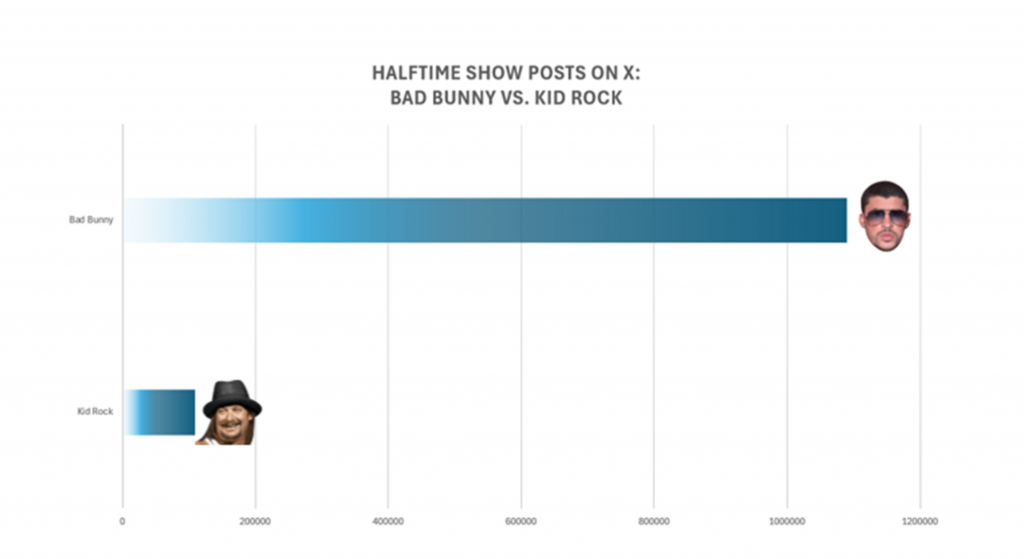
Highlights from the study include:
-
892.8% more posts on X about Bad Bunny’s halftime show performance
-
963.6% more posts about Bad Bunny throughout Super Bowl Sunday
-
Three times the search interest for “Bad Bunny” compared with “Kid Rock”
-
Thematic analysis showing appreciation for Bad Bunny’s celebration of inclusion, love and diversity
The results also revealed a strong emphasis on negativity in the online space, with each performance generating 2.5 times more negative posts than positive ones.
“The Super Bowl halftime show has historically been a platform for both entertainment and political expression, and this year was no exception,” said Dr. Jin-A Choi, Associate Professor at Montclair State University and director of data analytics for the Center for Strategic Communication. “With many viewers choosing sides based on their political beliefs, the contrasting reactions to both halftime shows underscore the ongoing debate about identity and representation in American culture.”
“While some have suggested that Bad Bunny’s Spanish-language performance might alienate viewers and drive them to alternatives, indications from the online space suggest this wasn’t the case at all,” said Dr. Bond Benton, Professor of Communication at Montclair State University.
“The Super Bowl halftime show has become a site of cultural negotiation, and our findings show audiences engaging far more with inclusive, multicultural performances than reactionary ones,” said Dr. Yi Luo, Associate Professor in the College of Communication and Media at Montclair State University.
The full study, available here, was conducted by Choi, Luo and Benton.
Media Contact: Keith Green, greenk@montclair.edu, 973-655-3701
About the College of Communication and Media: The College of Communication and Media (CCOM) offers a range of dynamic programs to a talented and diverse student population of over 2,000. Offering degrees in advertising, animation and visual effects, communication and media studies, film and television, journalism and digital media, social media and public relations, sports communication and an online, asynchronous MA devoted to strategic communication and media, the College prepares the next generation of communication and media practitioners and leaders. Founded in 2012 and housed in world-class, state-of-the-art facilities just 12 miles from New York City, the College is the only program in the country that offers the following opportunities for students: a radio station (WMSC), newspaper (The Montclarion), strategic communications agency (Hawk Communications), sports network (Red Hawk Sports Network) streaming platform (Hawk+), digital newsroom (News Lab) and studio, and a social media listening center (Joetta DiBella and Fred C. Sautter III Center for Strategic Communication). The College also has a Student Success team, including dedicated Career Services and Advising professionals who prepare students for the internship and job search process. Student projects and programs have recently received national recognition from PRSSA’s Bateman Competition, an Edward R. Murrow Award, several Marconi Award nominations, and College Television Awards (“Student Emmy” awards) from the Academy of Television Arts & Sciences. The College is also home to the Center for Cooperative Media, which serves the public by working to grow and strengthen local journalism and media. Through $7.1M in grants awarded over the last five years, the Center focuses on collaboration in journalism, media equity, media coaching and training, civic science and research. The Center is also home to the NJ Civic Information Consortium, the largest funder of media and journalism in New Jersey, granting more than $10M over the last five years to support independent local media, journalism and training initiatives.