
Montclair Life: Teaching Students to Think for Themselves in the Age of AI
How Dr. Freddie Harris uses writing, community research and a deeply human approach to help first-year students navigate – and thrive in – a world transformed by artificial intelligence
Posted in: Homepage News, Montclair Life
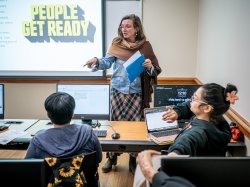
Through this photo essay – part of an ongoing series – we highlight how Montclair students, faculty and staff embody the University’s mission in the classroom, on campus and beyond – empowering a diverse community by providing broad access to rigorous learning, advancing research and creativity, and forming partnerships for the common good.
Photography by Mike Peters
Artificial intelligence is rewriting how we live, learn and work. Industries are shifting overnight. Workers are reevaluating their futures. And in classrooms across the country, educators are wrestling with a new reality: what does learning look like when a machine can generate an answer in seconds?
Dr. Fiona “Freddie” Harris thinks about these questions every day. As coordinator of the first-year writing program at Bloomfield College of Montclair State University, she’s dedicated to helping students build a strong foundation for the rest of their education – and their lives. That begins with honing the kind of critical thinking skills that can’t be outsourced to an algorithm.
Her approach starts close to home. Through a form of research called autoethnography – where students study their own communities by observing, documenting and analyzing everyday life – she pushes them to develop insights grounded in lived experience, not machine output.
And she doesn’t do this work alone. Dr. Harris is constantly in conversation with Bloomfield faculty about how to strengthen AI literacy and build assignments that nurture real critical thinking. The result is a first-year writing program that trains students to think boldly, question deeply and stay rooted in the human experience.
Where the Day Begins: Room 26, Siebert Hall

Inside Room 26 of Siebert Hall, Dr. Freddie Harris begins her day surrounded by reminders of the life she lived long before academia.
Her office is lined with photos from her years grooming and playing polo across England, Florida, Long Island and California – including a drawing of her beloved mare, Pumpkin, who was her companion for 20 years.
On her desk sits the buckle they won together at a three-show stock horse series, and nearby, a decorative box holds the ashes of her dogs Henry and Molly, who traveled the country with her.
Faculty in Conversation: Teaching in the Age of AI

Dr. Harris meets with professors Dr. Grace Cook and Dr. Nora McCook to strategize how Bloomfield faculty can better integrate AI literacy into their courses.
The trio spent part of the afternoon testing a WRT 105 assignment across different AI servers to see how the guardrails held up – a moment Freddie describes as “hilarious,” especially when the bot attempted to complete an autoethnography. “The bot can’t do that!” she laughs.
These ongoing conversations shape how the writing program prepares students to think critically in a world where AI tools are rapidly evolving.
Teaching Ethics, Community and Inquiry

In her noon section of WRT 105, Dr. Harris introduces the community autoethnography – a signature assignment where students observe, document and analyze a community they belong to.
The class begins with ethics: reviewing consent forms for interviews and discussing responsible qualitative research practices. Today, she guides them through taking field notes and sharpening their observational skills. One student, Winiga Batoma, is writing about his National Guard Squadron.
At times, Dr. Harris has students act out behaviors unusual for the community they’re studying – a playful way to highlight what counts as “normal” embodied practice and strengthen their analytic eye.
Using the Humanities to Meet a Changing World

During Bloomfield’s monthly faculty meeting, Dr. Harris and Dr. Nora McCook continue their ongoing dialogue about how qualitative research methods and humanities-based content can help students build stronger critical thinking skills in the age of AI.
She also presents an overview of the first-year writing sequence – WRT 105 and WRT 109 – highlighting how students learn to conduct community research, synthesize sources and translate academic work into public-facing genres.
Together, the faculty explore how writing instruction can evolve alongside artificial intelligence without losing its human heart.
Strengthening Skills, One Class at a Time

Dr. Harris ends her day with her second Writing 105 class, held in the library’s grand reading room – a space she loves for its bright, calming light.
At the start of each week, she shares Bloomfield’s “Strong Student” campaign slide, designed to make the habits of successful learners explicit, especially for first-year students.
Whether she’s guiding them through research practices or helping them access course materials, Dr. Harris grounds each lesson in the belief that small, consistent behaviors build confident thinkers.
A Different Kind of Classroom

Dr. Harris ends her day at Selah Yoga in Roseland, where she teaches both postural yoga and yoga philosophy alongside her friend Donna D’Onofrio.
In these photos, she moves through table-top and Cat-Cow postures – practices she says are especially helpful for maintaining spinal mobility as we age. Sitting just behind her is Bertram, her outspoken dachshund mix and loyal studio companion.
Whether in the classroom or the yoga studio, Dr. Harris’ work is centered on presence, connection and guiding people back to their own lived experience.
View more photos of Dr. Freddie Harris’s day as a professor at Bloomfield College.
Ready to Start Your Bloomfield Journey?
Plan your visit and take the first step towards applying to become a Bloomfield Bear.
Journalists: Contact the media relations team for assets or to schedule an interview.