How Montclair’s 4+1 Program Turned My Childhood Science Project into Real Marine Biology Research
At Montclair State University, the combined BS/MS in Marine Biology and Coastal Sciences helped Kelly Witters turn a third-grade horseshoe crab project into hands-on research for coastal conservation
Posted in: Graduate School, Homepage News, Research, Science and Technology
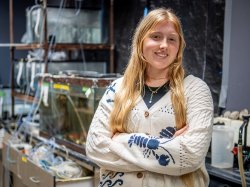
As a third grader, Kelly Witters ’26 built a sandy-beach trifold and a glass of “ocean” for a school project on horseshoe crabs – and never let them go. Today, as a graduate student in Montclair’s 4+1 (combined BS/MS) program in Marine Biology and Coastal Sciences, she has turned that early curiosity into a multiyear project on where and how horseshoe crabs spawn in Barnegat Bay, work that is helping scientists better protect both the shorebirds that depend on their eggs and the habitats horseshoe crabs need to survive.
“These shorebirds are important, but it’s just as important to know which areas need to be monitored and protected to support the horseshoe crabs,” Witters says. “If we lose the habitat and areas they use to breed and lay eggs, it will be hard to get that habitat back and keep the populations sustained.”
As a nationally recognized high-research university, Montclair State University gives students early access to faculty-led projects, which allowed Witters to join a lab in her first year and keep building her research skills in one continuous five-year path.
That early start is built into Montclair’s academic model: Montclair offers more combined programs than any other institution in New Jersey, giving students a head start on graduate study and careers. For Witters, that has meant not just upper-level science courses, but real ownership of a research question and presenting her findings at scientific conferences.
“I always thought it would be a fantasy to actually work with horseshoe crabs,” Witters says. “They were just my favorite animals. They’re so weird and unique – they have blue blood, they’re called crabs but are more closely related to spiders – and being able to build my own research around them really changed my life and showed me what I want to do.”
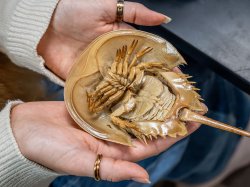
Turning a favorite animal into publishable research
Witters and her twin sister, Caitlin – who also majored in Marine Biology and Coastal Sciences, graduated in January 2026 and plans to join the U.S. Coast Guard – first joined Biology Professor Paul Bologna’s lab as freshmen, finding not just mentors but a close‑knit community of students working side by side in the field and lab.
When Bologna invited students to propose independent projects, Witters seized the chance to study her favorite animal more deeply, and together she and Bologna focused on a question that hadn’t been fully explored in New Jersey: whether quiet lagoonal back‑bay beaches are important spawning habitat for horseshoe crabs, not just the better‑known oceanfront beaches along Delaware Bay and the open Jersey Shore.
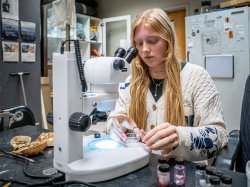
She times fieldwork with lunar cycles and high tides when spawning peaks. Back in the lab, she counts eggs and analyzes sediment types to see where egg densities are highest. The results are striking, and the work led to a peer-reviewed article co‑authored with Bologna in The Bulletin of the New Jersey Academy of Science. Seeing her name on a scientific paper is powerful confirmation that her research matters, she says.
Because Witters is in a 4+1 program, the project didn’t end when she finished her bachelor’s degree – it became the foundation of her master’s thesis. She had already begun taking graduate-level classes while completing her undergraduate requirements, so the transition to full-time graduate study felt natural. “We’re out in the field, on the water and in the lab, and the five-year program lets me start graduate-level work early and build my research over several summers,” she says.
Building toward a PhD and beyond
By the time she graduates with her master’s in 2027, Witters expects to have three summers of data on horseshoe crab spawning, experience presenting at national conferences and at least one publication – with more analyses underway. Along the way, she has also discovered a passion for teaching as a graduate assistant for introductory biology labs, working closely with undergraduates who, like she once did, are testing out a future in science. She continues to balance research with life on campus, from long days in the back bays of the Jersey Shore to training with Montclair’s varsity cross country team.
“Being able to build my own research around the animal I loved in third grade really showed me what I want my life to look like,” she says.
Ready to start your Montclair journey?
Fast-track your future with a Combined Program and earn two degrees in one streamlined path. Explore our accelerated, affordable options and see where your curiosity can take you.
Accepted students: Make it official by submitting your new student deposit and registering to attend Accepted Student Day.