Montclair State University Course Meets Growing Demand for Trauma and Resilience Training
Developed in partnership with New Jersey’s Office of Resilience, From Trauma to Healing transforms how professionals support youth, families and communities through healing-centered approaches
Posted in: College News and Events, College Spotlight, Homepage News and Events
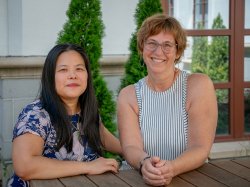
Family therapist and Student Assistance Counselor (SAC) Joy Przywara didn’t expect an online trauma course at Montclair State University to reshape her work and family relationships.
“The From Trauma to Healing: Healing-Centered Approaches to Trauma in Families and Communities course was so much more than I expected. I feel so much better prepared as a professional,” says Przywara. “I can say with confidence that this has changed my approach and deepened my understanding.”
A Needed Collaboration
Now in its third cohort, which begins October 13, the trauma-centered certificate course is a collaboration between Montclair’s Department of Family Science and Human Development (FSHD), in the College for Community Health, and the New Jersey Department of Children and Families’ (DCF) Office of Resilience.
The program is designed for professionals in the education, law enforcement, social services and mental health fields where understanding trauma’s impact is critical.
“We’re so deeply appreciative to Montclair for creating a course of this caliber,” says Office of Resilience Executive Director Rebecca Bryan. “Montclair was a perfect fit for this kind of work because it’s community focused, and we’re community focused.”
FSHD Chair Lyndal Khaw adds: “This course fulfills New Jersey’s goal of being a trauma-informed and healing-centered state, while advancing President Jonathan Koppell’s mandate to be a public-serving institution. It benefits professionals who work with people and helps strengthen communities around us.”
Impact on Professional and Personal Life
Przywara says the course has changed how she interacts in all her roles:
As a SAC at a vocational school where students are referred to her for a range of matters, sometimes behavioral issues: “There’s a story behind what students are doing. There’s a why, and once you get to that, you’re usually able to find a connection with the student.”
As a private practice counselor: “It is important to use a lens of understanding and compassion which comes from knowing and identifying the trauma and the ways to help them understand their own strengths in coping and processing that impact.”
As a wife, mother of a child with autism and a cancer survivor: “This has saturated my parenting, my relationship with my husband of 20 years; it’s made me reflective.”
For Przywara, the course revealed a key insight: “We’re not just damaged, we’re damaged and coping. That’s a special piece because then you’re not counseling ‘at,’ you’re counseling ‘with.’”
Developing the Curriculum
The 10-week online course explores healing-centered approaches within the context of social connection. Unlike traditional trauma-informed care, it emphasizes strength, resilience and wholeness in individuals, families and communities.
The curriculum blends research on neurobiological responses to trauma with practical applications. Graduates earn continuing education credits and a micro-credential certificate jointly from Montclair and the DCF Office of Resilience.
Khaw notes: “This was the first time FSHD offered a course designed to be community-serving and responsive. It’s an interactive, comprehensive look at trauma and how professionals can be more trauma-informed in their everyday practices to support families and children.”
Robin Wanner, a care manager supervisor at Bergen’s Promise, a community-based, nonprofit organization serving more than 1,700 youth and families in Bergen County, found the course invaluable: “In general, it helps you be a more sensitive individual, to understand or have a sensitivity to where people might be coming from in their humanity. It makes you step back and look at your own life or parenting or generations in your own family to recognize things you may not have understood before.”
Creating Resiliency in New Jersey
The Office of Resilience uses a Trauma-Informed Continuum – trauma aware → trauma sensitive → trauma responsive → healing centered. Bryan explains: “When you take the final step to become healing centered, you realize that we are more than our trauma. The trauma is a part of the story, but we’re already whole; we’re incredibly resilient. The focus is strengths-based.”
Demand for the course continues to grow, with enrollment doubling between the first and second cohorts. Khaw also sees potential for Montclair to expand teachings in professional development and micro-credentialing for graduates and early-career professionals.
About the Partnership
The New Jersey Office of Resilience, created in 2020, addresses the long-term effects of Adverse Childhood Experiences (ACEs) and promotes resilience. The office offers free statewide training, organizational support such as the Trauma Responsive Understanding Self-Assessment Tool and hosts networking opportunities through Resilient NJ Collaborative meetings.
In early 2021, New Jersey launched the Adverse Childhood Experiences Action Plan with the goal of preventing and reducing childhood trauma and adversity. The aim is to keep students safe, healthy and in school and create opportunities to prevent and empower healing from individual, transgenerational and community trauma,
Through its partnership with Montclair, the state reserves seats for employees and provides scholarships to community members to ensure accessibility. “One of our deeply held beliefs is that cost should not be a barrier to this knowledge,” says Bryan, emphasizing that “Montclair is a key component of taking trauma training to the next level. This is meant to be a long-term relationship.”
Ready to Start Your Montclair Journey?
Prospective Students and Parents: Plan your visit and take your first step in applying to become a Red Hawk. Learn more about the Department of Family Science and Human Development in the College for Community Health.
Journalists: Contact Media Relations for assets or to schedule an interview with faculty or students.