
Montclair State University Launches the New Jersey Center for Indigenous Justice
Posted in: Native American and Indigenous Studies
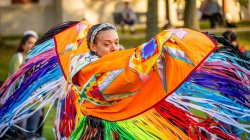
Montclair State University has taken another bold step in its ongoing commitment to Native communities with the official launch of the New Jersey Center for Indigenous Justice (NJCIJ) — a new hub for advancing Indigenous awareness, education, and justice.
On October 8, the University will host a Welcoming Ceremony to celebrate the new Center, featuring a traditional prayer, reflections from tribal leaders, and a performance by the Red Blanket Singers, a drum and dance group from the Nanticoke Tribe. The celebration will bring together students, faculty, staff, alumni, and community partners who helped bring the NJCIJ to life.
“We’re thrilled to welcome the NJCIJ to Montclair State University alongside our friends, partners, and longtime advocates. After years of hard work, it is inspiring to see this vision come to life. This is not only a meaningful milestone for Montclair but also for the wider New Jersey community,” says Precious Benally, Director of the New Jersey Center for Indigenous Justice.
“The Center brings together Montclair, community partners, and Native Nations to uphold Tribal sovereignty, amplify Indigenous voices, and create opportunities for students, faculty, and staff to learn and work alongside one another and with our Tribal partners with humility, creativity, and reciprocity.”
A Center Years in the Making
The Center grows out of Montclair’s Native American and Indigenous Studies program, which has steadily expanded since its creation to meet the priorities of New Jersey’s state-recognized Native nations — the Ramapough Lunaape, Nanticoke Lenni-Lenape, and Powhatan Renape. Those priorities include environmental justice, political recognition, language revitalization and the protection of cultural heritage.
“The NJCIJ will be the first and only university-based project in New Jersey that aims to transform public understanding of Native people and to do so in partnership with Indigenous communities across the state,” says Chris Matthews, chair of Anthropology, co-director of the Native American and Indigenous Studies (NAIS) program and co–principal investigator of the grant.
The University’s adoption of a Land Acknowledgement Statement in 2022, recognizing its location on Lenapehoking, marked a visible milestone in this work. Annual events such as Indigenous Peoples Day, NAIS lectures and panels, and the Summer Field School have deepened student engagement and public understanding.

Mellon Foundation Support
The NJCIJ has been made possible by a prestigious three-year, $1 Million grant from the Mellon Foundation, awarded to the NAIS program to establish the Center and expand its programming. The funding will deepen interdisciplinary research, support student initiatives, and create a digital repository of tribal knowledge using Mukurtu software to preserve oral histories, environmental justice archives and language materials for use by tribal members, faculty and students.
“The Mellon Foundation grant will significantly increase Montclair’s ability to fulfill our commitment to addressing the historical legacies of Indigenous dispossession and dismantling practices of erasure that persist today,” says NAIS co-director Mark Clatterbuck. “The new Center, in tandem with our NAIS program, is focused on Indigenizing New Jersey while decolonizing educational, social and political legacies that continue to overlook Native people and exploit Native lands.
Leading with Experience
At the helm of the NJCIJ is Precious Benally, an Indigenous (Diné) professional with more than a decade of experience in tribal law, policy and community engagement. She has worked with tribal governments, justice system practitioners, and federal agencies to design innovative solutions addressing governance, economic development, juvenile justice and social services.
Benally brings a leadership style grounded in listening and partnership. As Senior Advisor in the U.S. Department of Commerce’s Office of Native Affairs and Economic Development, she advised on tribal consultations and policy matters aimed at creating pathways for sustainable economic growth and self-determination. She also teaches Native American Law at Columbia and Brooklyn Law Schools, cultivating culturally competent classroom communities that engage deeply with Indigenous narratives and policies.
Her proven fundraising success — including securing over $2 million in federal grants — and extensive conference planning experience will strengthen the Center’s programming, community engagement, and resource development.
“I’m truly honored to step into this role as the Center’s first director and to carry forward the strong foundation built by my colleagues and our partners. My lived experience as an indigenous woman and my work supporting Native nation-building efforts have shown me the transformative power of community—and that’s exactly what drives the Center’s work. Our mission is simple but profound: to walk in partnership with Tribal communities to re-Indigenize New Jersey, while giving students meaningful, holistic learning experiences and transforming how the University lives up to its responsibility to society.”
Building Partnerships and Advancing Justice
Working closely with NAIS faculty and tribal leaders, the NJCIJ will serve as a center for communication, fundraising, events and gatherings that highlight the unique questions facing Montclair’s Indigenous students and New Jersey’s tribal communities. The Center embraces cultural traditions, community-led research and environmental stewardship, combating Indigenous erasure by ensuring that Indigenous leaders guide teaching, learning and public understanding.
Among its priorities:
- Community collaboration on language revitalization, sacred site protection and cultural preservation.
- Student engagement through field-based courses, mentorship and direct learning from Indigenous knowledge keepers.
- Digital preservation of oral histories and resources to ensure accessibility for tribal members and scholars alike.
The NJCIJ envisions a future where Indigenous histories and futures are honored and celebrated, where Native students thrive, and where public understanding of New Jersey’s Indigenous communities deepens through education, dialogue and justice-centered action.
Welcoming Ceremony – October 8 at 2:00 p.m.
In addition to the Red Blanket Singers and Dancers, the event will include a Land Acknowledgement reading, a traditional welcoming prayer, remarks from Dean Fatma Mili, NJCIJ Director Precious Benally, and tribal leaders Chief Mann and Chief Ridgeway. A reception will follow for conversation and community building. All are welcome to join in celebrating this significant accomplishment and the partnerships that made it possible.
Read More
On Their Land, In Their Voices
Students Plant Seeds to Revive a Native American Language