
From One Major to Three in Four Years: Connecting Data Science, German and Linguistics at Montclair
In a German language program for local children and on an archive translation project, Isabella Zarate Gonzalez shows how Montclair’s mix of STEM, world languages and community engagement helped her connect her interests into a single path
Posted in: Admissions, Humanities and Social Sciences, Science and Technology
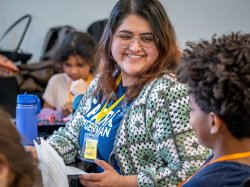
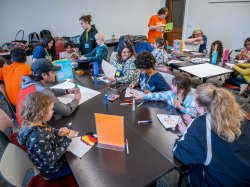
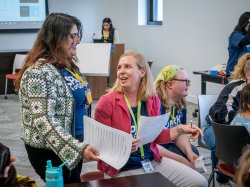
Triple major Isabella Zarate Gonzalez spends Friday afternoons helping children learn German in Montclair State University’s SPARK Lab, an after-school program that brings local elementary students to campus for games, songs and basic conversation.
As an international student from Mexico, she was drawn to Montclair’s computing program and the chance to build a tech career. After she excelled in a German language course, that success became the first step toward multiple degrees, as faculty encouraged her to add German, explore linguistics and step into teaching and research roles she had never considered. She even turned her work with children in German into a research project on how programs like the SPARK Lab influence college students’ interest in teaching.
“One of the most important things I’ve learned at Montclair is that you don’t have to limit yourself to just one thing,” Zarate Gonzalez says.
Community‑engaged learning that opens doors
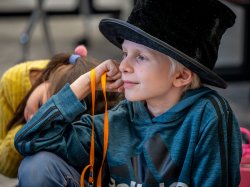
The SPARK Lab is a partnership between Montclair and nearby schools, giving children early access to world languages while mentoring college students into community‑focused leadership roles. It is part of a national network supported by the American Association of Teachers of German and the Goethe‑Institut. Zarate Gonzalez is among the students who teach German to elementary school children one hour a week for six weeks each semester, including a Meistergruppe for kids who speak German as a heritage language.
As part of a multi‑university research project with the University of Tennessee Knoxville, the University of St. Thomas and the University of Chicago, she led data collection and analysis on how SPARK affects college students. She focused on whether experiences like the SPARK Lab encourage students to consider teaching German and what broadly applicable professional skills they gain, surveying Montclair’s student instructors about their motivations and how teaching had changed their career plans.
The research findings, co‑authored with faculty and collaborators at the four campuses, were published in a peer‑reviewed journal and presented at the 2023 American Council on the Teaching of Foreign Languages conference in Chicago.
Studying abroad with scholarship support
Scholarship support opened the world for Zarate Gonzalez.
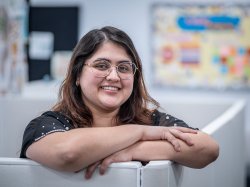
Through the Montclair–Graz Sister City Scholarship, she spent the 2024–25 academic year studying in Graz, Austria. The full scholarship, funded by Montclair State University, Montclair’s Overseas Neighbors and the City of Graz, provides free tuition, room and a small stipend and sends two Montclair undergraduates each year to study in Montclair’s sister city.
Montclair’s status as a Hispanic‑Serving Institution also helped her win a full scholarship to Middlebury’s prestigious German Language School, a summer immersion program.
“There aren’t a lot of people who can say, ‘This university allowed me to do three bachelor’s degrees, win full scholarships and study abroad in Europe,’” she says.
Hands-on research and a peek into history
Advanced language study also led Zarate Gonzalez into meaningful work and helped her discover the academic field that ties her interests together. With Associate Professor Pascale LaFountain and local resident Diane Forman, she worked on a translation project for an extraordinary archive of Austrian Jewish history centered on Forman’s grandfather, composer Wilhelm Grosz.
The team organized and translated Grosz’s letters – including correspondence with figures such as Leonard Bernstein and Langston Hughes – along with his musical manuscripts, Nazi‑era property documents and personal library, preparing the materials for the Exil.arte Jewish music archive in Austria.
For Zarate Gonzalez, working so closely with those documents made the Holocaust feel personal and showed her how language skills and data‑driven thinking could come together in fields like Computational Linguistics.
Looking ahead
When Zarate Gonzalez graduates in May 2026, she will have earned degrees in Data Science; Language, Business and Culture; and German, plus a minor in Linguistics – all completed in four years.
Now, as she looks ahead, she is exploring teaching opportunities in both German and STEM fields and planning for a future master’s program in Computational Linguistics.
“I think about what would have happened if I had chosen not to come to Montclair,” she says. “My life would be completely different. I genuinely believe I got the most out of it.”
Ready to start your Montclair journey? Learn more about the College of Science and Mathematics and the Department of World Languages and Cultures at Montclair.
Accepted students: Make it official by submitting your new student deposit and registering to attend Accepted Students Day.