
Montclair 250

The 250th anniversary of the birth of our nation can be an occasion for looking back. It can also be a time to look forward. The American Experiment began in 1776 and has been evolving and changing ever since. The founders of this bold experiment in self governance understood that a democratic republic required perpetual vigilance and it needed to be adaptable.
They also recognized that an educated citizenry is essential to democracy. This required universal education, which required teachers. Originally founded as Montclair Normal School, a teachers’ college, Montclair maintains its mission to prepare students to “flourish as collaborative, compassionate citizen-leaders.”
Beginning with the President’s Fall 2025 lecture series through the end of 2026, Montclair State University will be exploring various facets of what American innovation and ideals mean two and a half centuries later. This work will span across academic disciplines to show the full range of how far our country has come and where we must improve.
President’s Lecture Series
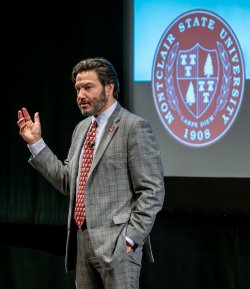
In this lecture series, President Jonathan Koppell explores the American Experiment, its founding principles, the role of higher education and both contemporary and future challenges and opportunities.
Each session will include a formal lecture focusing on different aspects of the American Experiment followed by a discussion with a thought partner with relevant expertise.

We Hold These Truths: From Declaration to Forming a Nation
Wednesday, October 15, 2025, 5:30-6:30pm Presentation Hall
The American Experiment is about more than the principles and structures articulated in the Declaration of Independence and the US Constitution. These documents laid out the premises and philosophy of a new nation and the architecture of its government. Over the last 250 years, the United States of America has emerged from this foundation to become a global leader in economic, political, military and cultural terms, built on a framework of core beliefs and practices animated by the challenges, opportunities and crises of our history. This lecture establishes the core features of the American Experiment – with an emphasis on first principles of American democracy such as individual rights, limited power and popular sovereignty – and serves as an “overture,” introducing the themes and melodies that will recur throughout the series.
This lecture includes a response from Dr. Fanny Lauby, Associate Professor, Political Science and Law
Rule of Law and the Core American Institutions
Thursday, November 6, 2025, 5:30-6:30 pm Leshowitz
The Declaration of Independence lays out a legalistic argument for separation from Great Britain. With this start, the founders placed the primacy of law as bedrock principle of a new nation. Many of the features ultimately enshrined in the Constitution rest upon this base including separation of powers, checks and balances, judicial independence, federalism, and state’s rights. Our system of market capitalism stems from the same starting point with an emphasis on property rights, contract and state enforcement.
President Koppell is joined in conversation by New Jersey Attorney General Matthew J. Platkin. Together they trace rule of law as a through-line of American democracy that predates the founding of the United States and has served as the logic model for the conflicts and controversies that have shaped the American experiment.
E Pluribus Unum
Monday, December 1, 2025, 10:00-11:00 am Presentation Hall
The Latin phrase “E pluribus unum” (Out of many, one) is the motto on the Great Seal of the United States. Originally representing the unity of the thirteen colonies forming a single nation, the phrase expanded to encapsulate the idea that we can be a single people with varied backgrounds and histories. In both ways, this motto has often been more aspiration than description. This lecture explores, what makes us one nation? Is it simply a legal definition, a shared heritage or commitment to a set of ideals? How do we function as a unified nation when the framers fractured power purposely? What are the features of the U.S. that have bonded communities and institutions together in the face of divisive forces?