Playing Sustainability Monopoly with the PSEG Institute for Sustainability Studies
Posted in: In the Community
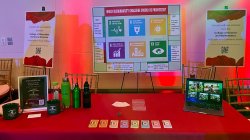
On Thursday, April 16th, Montclair State University welcomed alumni, friends, and community partners to Celebrate Montclair: A Spring Gala, hosted by President Jonathan Koppell and the Montclair State University Foundation. This evening affair featured representatives from across the University hosting booths showcasing the breadth of knowledge, expertise, and engagement that Montclair State University is known for. The PSEG Institute for Sustainability Studies was honored to be selected to represent the College of Science and Mathematics and engage attendees in a sustainability-themed activity and highlight our flagship Green Teams Internship Program.
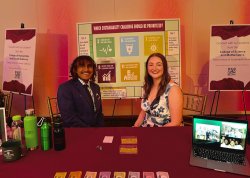
Throughout the evening, PSEG ISS Director Dr. Alex Moore and two Green Teams Alum, Mahir Ahmed and Sydney Mullin, invited attendees to play a round of “Sustainability Monopoly”.
For this activity, we asked attendees the simple question: “Which Sustainability Challenge Should Be Prioritized?” Based on the United Nation’s Sustainable Development Goals (SDGs), we provided six potential options:
- SDG 3
- Good Health and Well-Being. This goal aims to ensure healthy lives and promote well-being for all at all ages.
- SDG 6
- Clean Water and Sanitation. This goal aims to ensure the availability and sustainable management of water and sanitation for all.
- SDG 7
- Affordable and Clean Energy. This goal aims to ensure access to affordable, reliable, sustainable, and modern energy for all.
- SDG 8
- Decent Work and Economic Growth. This goal promotes sustained, inclusive, and sustainable economic growth, full and productive employment, and decent work for all.
- SDG 11
- Sustainable Cities and Communities. This goal promotes inclusive, safe, resilient, and sustainable cities and human settlements.
- SDG 13
- Climate Action. This goal promotes urgent action to combat climate change and its impacts.
Gala attendees were asked to roll a pair of 6-sided dice, which determined their “budget”, ranging from $500 to $10,000. Participants were then asked to select the denomination of bills they preferred for their budget and to allocate their funds across the six Sustainable Development Goals as they saw fit. Through this activity, we aimed to model the resource limitations that constrain our ability to address sustainability challenges, as well as highlighting the areas that each individual valued most based on how they distributed their funds.
At the end of the evening, we tallied the results and found that gala attendees prioritized donating to “Good Health and Well-Being,” “Sustainable Cities and Communities,” and “Clean Water and Sanitation” (see the table below for complete results). “Good Health and Well-Being” received the highest total and also had a concentration of higher denomination bills (primarily $1000s and $500s), suggesting stronger or more confident allocation decisions among donors.
| Sustainable Development Goal | Total Donations Received |
|---|---|
| 3. Good Health and Well-Being | $26,700 |
| 6. Clean Water and Sanitation | $20,400 |
| 7. Affordable and Clean Energy | $15,100 |
| 8. Decent Work and Economic Growth | $8,650 |
| 11. Sustainable Cities and Communities | $24,950 |
| 13. Climate Action | $14,100 |
“Decent Work and Economic Growth” received the lowest total overall. Several participants mentioned that this area may already receive significant attention and investment, which contributed to their decision to donate to other Sustainable Development Goals. Further, some participants noted that the “Climate Action” SDG felt more broadly or vaguely worded, which impacted their allocations.
Altogether, we observed strong and thoughtful participation throughout the evening, highlighting a clear desire among gala attendees to engage in meaningful discussions around the actions required to address today’s sustainability challenges. While the donations received were fake, the resulting distribution provides an opportunity for the PSEG ISS to develop programming that aligns with these donor-identified priority areas. As we prepare for our 2026 Green Teams Program, we will be expanding our staff to begin developing new initiatives that directly address the areas of concerns identified by Montclair community members. We’re excited to build on the success of the Green Teams to support sustainability solutions within our local communities, and to serve as a model for larger scale action that can take place regionally and globally.