
Shared Neural Substrates Support Evolutionary and Developmental Shifts in Sensorimotor Integration
Bruce Carlson, PhD
Professor of Biology, Washington University.
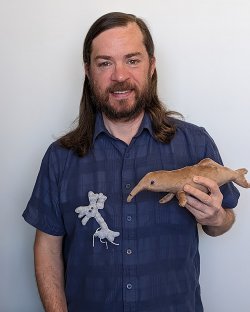
Bruce Carlson received his Bachelor of Science degrees in Biology and Marine Science from the University of Miami in 1997. He received his PhD in Neurobiology & Behavior from Cornell University in 2003, working with Carl Hopkins on the neural mechanisms for electric signal production in mormyrid weakly electric fish. He went on to do a postdoc with Masashi Kawasaki at the University of Virginia, where he studied neural mechanisms for integrating amplitude and timing information in the electrosensory pathways of African and South American wave-type weakly electric fish. He started his own lab at Washington University in St. Louis in 2008, where he has remained since. His lab is broadly interested in the evolution of information processing, and they use weakly electric mormyrid fish to study such topics as temporal processing by sensory systems, sensorimotor integration, social behavior and communication, and brain evolution. He recently became co-director of the Neural Systems & Behavior course at the Marine Biological Laboratory in Woods Hole, MA.
Abstract
Distinguishing between sensory inputs caused by your own actions and those arising from the outside world is a fundamental problem shared by all animals. Mormyrid fishes communicate using electric organ discharges (EODs). Electroreceptors specialized for communication respond to both self-generated (reafferent) and externally generated (exafferent) EODs. To distinguish between reafferent and exafferent EODs, an internal copy of the EOD command, termed corollary discharge (CD), signals the timing of EOD production. CD briefly inhibits central electrosensory neurons to block responses to reafferent EODs. EOD duration is diverse across species, and CD timing has evolved to maintain a precise match between the timing of inhibition and reafferent sensory input. Similarly, seasonal increases in testosterone reversibly elongate male EODs, and testosterone shifts CD timing in the brain to match the resulting shift in reafferent input. Further, developmental changes in EOD duration in some species are matched by changes in CD timing. Recent studies have revealed that these changes in CD timing occurring across evolutionary, developmental, and seasonal timescales all arise from a shared underlying mechanism. This suggests that sensorimotor systems can evolve a common solution for temporal coordination across timescales, which may facilitate developmental and evolutionary change in behavior.