Voicing the Stage: Students Make Musical Theater Accessible
Students create a live audio description of La Llamada for blind and low vision audiences
Posted in: Faculty News, News & Events
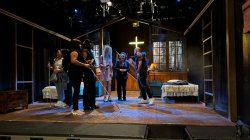
This Spring, Montclair students, in collaboration with the Repertorio Español, gave a live audio description of Javier Ambrossi and Javier Calvo’s La Llamada to low vision patrons of the theater. Audience members with visual impairments were able to listen to a narration of the theatrical performance through headphones.
For the final project in Audio Description (SPAN 429), students had the option to collaborate with their peers to create a script to describe a theatrical piece to a real audience. The course, taught by Dr. María José García Vizcaíno, has staged four previous projects, but this was the first to take on a musical—a new challenge that required nearly two months of preparation. Dr. García Vizcaíno noted that the experience was both fun and highly productive, giving students an invaluable hands-on learning opportunity.
Creating Inclusive and Engaging Theater
Preparation for audio describing La Llamada began with students going to the Repertorio Español to experience the show live. The Repertorio also provided a video of the performance, which students used for rehearsals. With 11 students participating, the script was divided into equal sections. During practice sessions, students collaborated to edit and refine each section until deciding on a final script.
This collaboration between Montclair and the Repertorio Español has allowed theater arts to become accessible to many more people. “After several years promoting these special performances, we have seen how important it is to open our doors to everyone and facilitate the access to plays and musicals without any barrier,” said Rafael Sánchez, Director of La Llamada and the Repertorio Español.
When asked about the importance of making art accessible, Anne Marsac, one of the students involved said, “It’s important because it reaches so many more people…It can be for all people because you can experience art in all different ways.” The audio description for them “was a cool experience because you had to be efficient with your words to best describe what the audience was seeing.”
Audio describing a musical presented unique challenges, so the team developed creative strategies to keep the narration engaging. While audio descriptions are usually usually given in a monotone voice, the students “broke the rule a little,” as Dr. García Vizcaíno explained, adding subtle shifts in tone to convey drama, laughter, and moments of mystery throughout the performance.
“One strategy was to choose words that were comical…The audience isn’t going to expect you to say that swear word or that irreverent adjective and it’s going to provoke humor,” said Dr. García Vizcaíno.
The dancing is an essential part of the story and also needed to be carefully described. Dr. Raul Galoppe, who was teaching about translating Broadway musicals into Spanish during the Spring semester, collaborated on this project and supported the team during the live performance. He assisted with sound and guided the team describing dance sequences, helping students describe the dancing while allowing room for the music to shine through.
“You have to be very succinct in how you’re going to interject the description of the actions,” said Dr. Galoppe.
Pre-Show Experience
This project also includes a pre-show tactile experience which allows the blind and low vision audience members to feel key components of the production. “Sometimes, due to the tech specs of the productions, a tactile experience may be easier for the productions. But in the case of “La Llamada“, we had the chance to bring everyone on stage before the performance to have a real idea of space size, elements, materials, textures and colors,” said Director Sánchez.
The audience members were able to touch key objects, furniture and walk through where the band was set up. “In the case of La Llamada, where we have transformed the whole theatre into a cabin in the woods, including the sound environment, I think it helps everyone to feel part of the story they are experiencing,” said Director Sánchez.
Dr. García Vizcaíno has expressed great interest in continuing this program with the help of the Repertorio Español. Working to elevate communities and make theater arts accessible to everyone is just one of the incredible things students of the CHSS do.
Written by Vivvy Gundani