
Echoes: An Unfinished History of Bondage
Posted in: Homepage Features
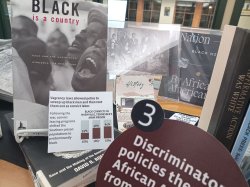
Through exhibits at Bloomfield College Library, we endeavor to tell stories, highlight narratives, and share themes through visual representations that are artistic and unique. As scholars of African American history, we read, study, and reflect on not only events, dates, legislation, and movements; but on the repercussions, legacy, and generational trauma that continues to affect our culture, affect our wellness, and affect our trajectory in the present.
Within the SEEDS curriculum this session, students are exploring how forms of inequality developed and how they continue to function today. Part of the role of libraries within this research and thought process is to facilitate access to information that is factual, that includes diverse viewpoints, and includes voices that critique established narratives. We think about who the creators are of that history, who the literature reflects, and whose voices have been left out or marginalized within that conversation. As a part of critical information literacy, students are encouraged to critically evaluate the sociopolitical structures that influence information creation. Providing accurate information about the history of racism, including its systemic impact serves as an impetus for further research, discussion, and debates.
Our current exhibit, “Echoes: an Unfinished History of Bondage,” is inspired by current conversations and scholarship related to reparations and the legacy of slavery in the United States. It reflects on the contributions of African Americans that were central to the foundation of wealth and capitalism in the United States. Moving further through history, it includes information regarding how African Americans, for generations, were systematically blocked from accessing the wealth created and in what ways that was manifested. The hope is that this exhibit will spark the viewer’s interest to research more, create new knowledge, and extend the scholarly conversation even further into any multitude of directions. Within our references are books, articles, images, government documents, movies, documentaries, poetry, music, and literature. There is the opportunity to explore a wide range of library resources that support research that is ongoing and lasts throughout the year.
On February 25th at 7 PM, The Library Resources Feature: Black Freedom & Struggle in the United States and the Black Studies Center will demonstrate resources such as the Schomberg Studies on the Black Experience and offer strategies for navigating these resources to connect to additional content reflective of this month’s exhibit theme.
Below lists some of the items in this exhibit:
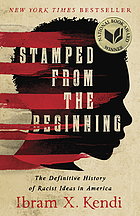
Stamped from the beginning : the definitive history of racist ideas in America
By Ibram X. Kendi
New York: Nation Books, [2016]
Summary: Americans like to insist that we are living in a postracial, color-blind society. In fact, racist thought is alive and well; it has simply become more sophisticated and more insidious. And as historian Ibram X. Kendi argues, racist ideas in this country have a long and lingering history, one in which nearly every great American thinker is complicit. Kendi chronicles the entire story of anti-Black racist ideas and their staggering power over the course of American history. Stamped from the Beginning uses the lives of five major American intellectuals to offer a window into the contentious debates between assimilationists and segregationists and between racists and antiracists. From Puritan minister Cotton Mather to Thomas Jefferson, from fiery abolitionist William Lloyd Garrison to brilliant scholar W.E.B. Du Bois to legendary anti-prison activist Angela Davis, Kendi shows how and why some of our leading proslavery and pro-civil rights thinkers have challenged or helped cement racist ideas in America. As Kendi provocatively illustrates, racist thinking did not arise from ignorance or hatred. Racist ideas were created and popularized in an effort to defend deeply entrenched discriminatory policies and to rationalize the nation’s racial inequities in everything from wealth to health. While racist ideas are easily produced and easily consumed, they can also be discredited”–From publisher’s website.
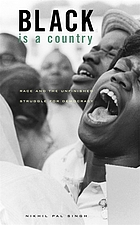
Black is a country : race and the unfinished struggle for democracy
By Nikhil Pal Singh
2005 First Harvard University Press paperback edition.
Cambridge, Massachusetts: Harvard University Press, 2005.
Summary: Nikhil Pal Singh asks what happened to the worldly and radical visions of equality that animated black intellectual activists from W.E.B. Du Bois in the 1930s to Martin Luther King, Jr., in the 1960s. In so doing, he constructs an alternative history of civil rights in the twentieth century, a long civil rights era, in which radical hopes and global dreams are recognized as central to the history of black struggle.” “Finding racism embedded within the universalizing tones of reform-minded liberalism at home and global democratic imperatives abroad, race radicals alienated many who viewed them as dangerous and divisive. Few wanted to hear their message then, or even now; and yet, as Singh argues, their passionate skepticism about the political promises made on behalf of the U.S. liberal democracy remains as indispensable to the project of racial justice today as it ever was.
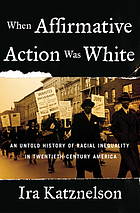
When affirmative action was white : an untold history of racial inequality in twentieth-century America
By Ira Katznelson
New York: W.W. Norton, c2005.
Summary: “A work that exposes the twisted origins of affirmative action”–Provided by publisher.
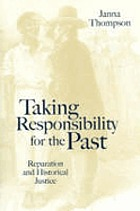
Taking responsibility for the past: reparation and historical injustice
By Janna Thompson
Cambridge, U: Polity; Malden, MA: Blackwell Publishers, 2002.
Summary: The book argues that the problems posed by historical injustices are best resolved by a reconciliatory view of reparative justice and an approach that explains how people acquire intergenerational responsibilities and entitlements. It ranges in its subject matter from the claims of indigenous people to land stolen from their ancestors to the growing movement for reparations for slavery. The book provides an original and convincing answer to the questions of how citizens can have reparative responsibilities for wrongs committed before they were born, and why descendants of victims may be entitled to compensation for historical injustices such as slavery. It also explains how members of nations can make recompense for injustices of the past without ignoring the inequities of the present.” “Taking Responsibility for the Past is a significant contribution to philosophical and legal debates about reparative justice, and at the same time an accessible and thought-provoking book for general readers.–Jacket.
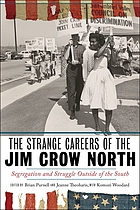
The strange careers of the Jim Crow North: segregation and struggle outside of the South
Brian Purnell (Editor), Jeanne Theoharis (Editor), Komozi Woodard(Editor)
New York: New York University Press, [2019]
Summary: The Strange Careers of the Jim Crow North explores the topics of racism and segregation”– Provided by publisherDid American racism originate in the liberal North? An inquiry into the system of institutionalized racism created by Northern Jim Crow Jim Crow was not a regional sickness, it was a national cancer. Even at the high point of twentieth century liberalism in the North, Jim Crow racism hid in plain sight. Perpetuated by colorblind arguments about “cultures of poverty,” policies focused more on black criminality than black equality. Procedures that diverted resources in education, housing, and jobs away from poor black people turned ghettos and prisons into social pandemics. Americans in the North made this history. They tried to unmake it, too. Liberalism, rather than lighting the way to vanquish the darkness of the Jim Crow North gave racism new and complex places to hide. The twelve original essays in this anthology unveil Jim Crow’s many strange careers in the North. They accomplish two goals: first, they show how the Jim Crow North worked as a system to maintain social, economic, and political inequality in the nation’s most liberal places; and second, they chronicle how activists worked to undo the legal, economic, and social inequities born of Northern Jim Crow policies, practices, and ideas. The book ultimately dispels the myth that the South was the birthplace of American racism, and presents a compelling argument that American racism actually originated in the North.