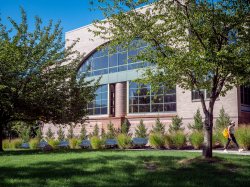
From the Bloomfield College Archives: Foundations
Posted in: Homepage Features
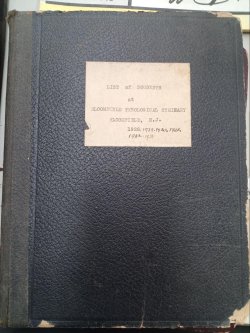
An exploration of archival materials at Bloomfield College may lead you to the historical period of the mid-to-late 1800s. The institution that Bloomfield College would evolve from was in place before the start of the 20th century.
Its earliest foundations can be found in the formation of the German Theological Seminary of Newark, NJ in 1868.
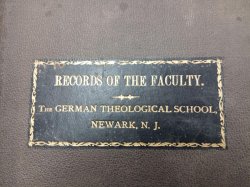
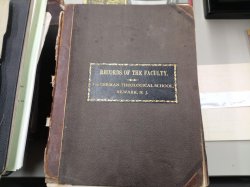
This theological seminary relocated to Bloomfield in 1872 to occupy the Bloomfield Academy Building, later named Seibert Hall which still stands today as a part of Bloomfield College. By the time The New Jersey State Normal School at Montclair opened in 1908 as a predecessor to Montclair State University, the theological seminary in Bloomfield prepared to launch its Bachelor of Arts degree program to begin the following year. This would be in addition to the Bachelor of Divinity that was already in place.
As an institution, its original purpose was to serve Newark and surrounding communities, including Orange, Paterson, Hoboken, and Jersey City. At that time, in the city of Newark, census data indicated that almost a third of all residents were of German descent. Many Germans traveled to the United States between the years of 1848 and 1860 after the failed European Revolutions of 1848. Under the direction of the Presbytery of Newark, The German Theological Seminary of Newark saw itself as “the mediating agent through which the immigrant could gradually adjust to American life,” as discussed in Harry Taylor’s Bloomfield College: The First Century: 1868-1968. By the early 1900s immigrants from Italy, Hungary, and other European nations enrolled in the seminary. With these changes, by 1913, it appeared that students of German heritage were no longer the majority of the student body as had been the case at the seminary’s inception about forty-five years prior. The demographic breakdown of the school quickly grew to reflect the language and cultural backgrounds of many different origins, and the German Theological Seminary was renamed Bloomfield Theological Seminary.
For families who trace their ancestry to students who attended the Theological Seminary that would eventually evolve into Bloomfield College in 1961, handwritten records from the Libraries’ archives can serve as a resource for confirming where their relatives may have resided, their ages, or their guardians. Census records by this time will have listed the individual names, ages, and places of birth of each member of a household. However, to complement census records, these handwritten school records from the Bloomfield College Archives, often list the church the student belonged to, courses the student took, as well as their individual accomplishments; which can lead researchers to more information about who that student was and the life that the student lived.
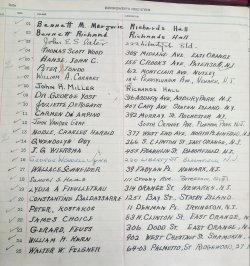
The above archival item demonstrates the range of places in Essex County and surrounding areas of both New York and New Jersey that some seminary students came from by the mid-1950s. At this time the institution was known as “Bloomfield College and Seminary.”
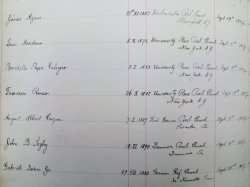
This archival item shows a student who was born in 1862 and began studies at the seminary on September 19th, 1907. Within just these few lines, students range from ages 25 through to 45, as they begin their seminary studies.
Additionally, by reviewing handwritten letters from the late 1800s within the Bloomfield College Archives, a window is opened that helps reveal how education was structured at that time period, as well as the society that the institution existed within overall, and the cultural norms and expectations that were in place. Understanding education history, including who had access to schooling during these time periods, what classes were being taught, and how these students’ educations were funded; are all questions that can be asked as we explore these Bloomfield College archival materials. These are original historical artifacts that are unlikely to exist anywhere else.
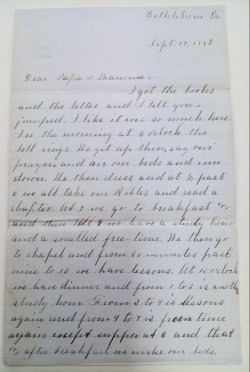
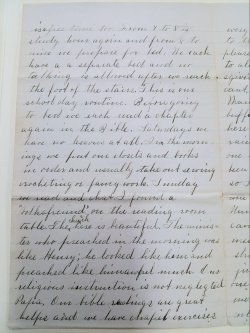
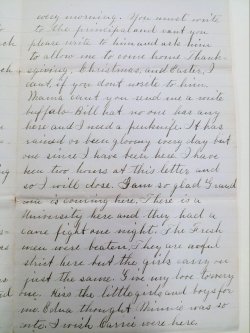
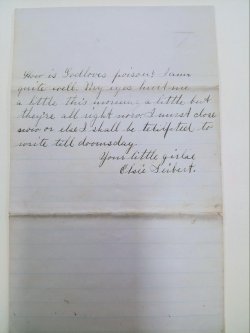
(A letter written in 1889, from a collection of Reverend George Seibert’s family letters, during the time that he led The German Theological Seminary of Newark, NJ)