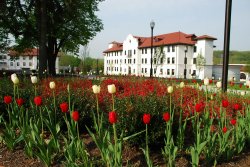
SEEDS Curriculum Mission Statement
Education is a process of self-discovery and growth. The Montclair SEEDS curriculum encourages students to uncover what excites and motivates them. Our world faces significant social, cultural, and environmental challenges and needs citizens with passion and purpose who think critically and creatively, communicate clearly, and act ethically. The Montclair SEEDS curriculum will strengthen and build upon students’ existing skills and teach them new ways to embrace the world around them.
Documentation
SEEDS VALUES.
Social Justice and Equity.
Students will learn how different forms of inequality (social, economic, environmental, racial, gender) have developed; the history of those who have struggled against injustice; and the many ways in which inequality continues to function in present day society.
Educated Citizenry (Critical Information Literacy) (PDF)
Students will learn to assess, produce, and communicate knowledge as informed and responsible citizens, and learn to critically evaluate the sociopolitical structures that influence information creation.
Engagement, Agency, and Leadership.
Students will learn how to engage with issues in their communities and develop the confidence and strategies to become leaders and contribute to the public good.
Diversity and Intercultural Competency.
Students will develop the ability to understand diverse cultural contexts and to communicate and function within them.
Self-Discovery and Self-Care.
Students will be introduced to multiple disciplinary approaches towards achieving a healthy, meaningful, and productive life, and, along the way, develop a sense of self.
SEEDS Curriculum Student Learning Outcomes and Rubrics.
Foundations (18- 21 credits).
- All learning outcomes in the Foundations area are required (15-18 cr).
- The second course of Effective Writing can be taken within the major where available.
- Students who can demonstrate intermediate proficiency in a foreign language can fill this requirement with only 3 credits. Students who choose to start the study of a new language will be required to take 6 credits.
Explorations (12 credits)
- Students are required to take 12 credits.
- Students can choose 4 from the 6 learning outcomes in this area.
- It is not allowed to choose the same learning outcome more than once.
LIST OF APPROVED SEEDS COURSES.
Montclair SEEDS Curriculum Implementation 2025-2026.
Starting in Fall 2025 Montclair SEEDS curriculum will be implemented among all new students. In preparation for these, it is important that faculty advisors become familiar with the new SEEDS curriculum. University College Advising team have prepared a training module for anyone wishing to learn about the SEEDS curriculum. You can access the Montclair State SEEDS Training Module by following this link.
Certification 2025-2026.
- A new round of certification will start on September 2nd 2025. All proposals seeking SEEDS certification can be submitted using the Course Management Inventory (CIM) system.
- Starting in Fall 2025 the Advisory Board will start the process of re-certification of courses that were given a two-year certification during the 2023-2024 academic year. The certification of these courses expires on Spring 2027.
- New courses should get SEEDS certification before they seek curriculum approval.
- Starting in Fall 2024 courses certified in the SEEDS curriculum will have a five-year certification.
- The learning goals of the course must be aligned with ONE of the Student Learning Outcomes (SLO) in the SEEDS curriculum.
- The instructor(s) of the course agrees to participate in the assessment of the SEEDS curriculum. Participation includes submitting samples of student work and distributing other indirect assessment measures.
- The purpose of the course will be aligned with one of the SEEDS Values.
- Faculty will be invited to participate in the creation of instruments to assess the SEEDS values.
SEEDS certification requests must be submitted using the Course Inventory Management (CIM) system.
Guidelines to submit courses for SEEDS Certification or Re-certification using CIM.
ACCESS CIM HERE
If you have problems accessing CIM please email Carlin Soos.
Use this link to determine when a SEEDS course is due for recertification.
SEEDS Curriculum Assessments.
Last year, we conducted the assessment of Foundations courses. This year, we will conduct assessment of Explorations courses according to the following schedule:
Fall 2025
- Analyzing Cultures and Societies.
- Ethical Inquiry
- Cultural Expression
Spring 2026
- Literary and Artistic Analysis
- Historical Thinking
- Scientific Reasoning
Assessment Process.
- Chairs and program heads responsible for courses due for assessment this year will be contacted by the SEEDS directors to organize the assessment process.
- If you have questions about the assessment process, please contact the SEEDS directors: Dr. Kate McCaffrey or Dr. Esperanza Brizuela-Garcia.
Future Assessments.
Fall 2026
- Revision and Preparation.
Spring 2027
- Effective Writing II
- Creative Expression
- Analyzing Cultures and Societies
Fall 2027
- Effective Writing I
- Ethical Inquiry
- Literary and Artistic Analysis
Spring 2028
- Quantitative Reasoning
- Historical Thinking
- Scientific Reasoning
Fall 2028
- Interactive Communication
- Political and Civic Life
- World Languages
Spring 2029
- Analysis and Reporting
SEEDS Values Workshops
ENGAGEMENT, AGENCY AND LEADERSHIP.
We are reaching out to faculty currently teaching in the SEEDS program who have selected Engagement, Agency and Leadership as a SEEDS value. We are rescheduling an on-campus, in person workshop on Monday, November 17 from 1-3:30, Cole 340 to explore, refine, and finalize the definition of this value. Our workshop will be led by our colleague Todd Kelshaw who has been deeply involved in both the SEEDS program and civic engagement initiatives on campus. Please join us and share this invitation to any faculty in your program who teach relevant classes.
Purpose: SEEDS values are intended to communicate to non-major students the value of our core curriculum. When we teach students Engagement, Agency and Leadership, what is important for them to know? What are the basic, non-negotiable lessons we intend to communicate in these classes? Does teaching Engagement, Agency and Leadership involve pedagogical considerations, or is the main concern content, or both? Our workshop will establish the basic principles of what teaching this SEEDS value asks of instructors.
Why: The parameters we finalize will be key to developing coherence in the curriculum as well as an assessment plan. We believe it is important for the people who are teaching Engagement, Agency and Leadership to participate in its definition, so we hope you will attend.
Date and location: November 17, 1:00- 3:30pm. Cole Hall 340.
We kindly request that you pre-register here.
EDUCATED CITIZENRY.
Are you teaching a course that addresses the Educated Citizenry (Critical Information Literacy) SEEDS Value? Or teaching a Foundations or Explorations course that includes (critical) information literacy skills as part of its Student Learning Outcomes? Librarians would love to work with you to guide students through different stages of the research process, such as developing a focused topic, finding credible sources, evaluating information, and more. Librarians:
-
can collaborate on research assignment design and embedding learning materials into your courses.
-
can teach synchronous (in-person or online) sessions for your classes; request a library instruction session here.
-
can provide helpful asynchronous learning materials (e.g., guides, videos, modules).
-
For example, an Educated Citizenry guide geared towards undergraduate students has been added to many of the Libraries’ subject guides (e.g., Biology, Educational Foundations, Linguistics), which are already integrated into Canvas course sites under the Library Resources tab.
-
-
offer many free in-person and online Libraries workshops to students (register here).
-
can support students who are struggling; students can make a research appointment with a librarian or drop-in during librarian office hours at Sprague Library (Monday-Friday, 11am-3pm).
The University Libraries has drafted an Educated Citizenry/Critical Information Literacy rubric and guide for faculty, with sample activities and assessments. We were asked to develop an assessment for the Educated Citizenry SEEDS Value and would like to invite faculty who are interested in working with us on this to reach out to Bonnie Fong (Head for Research & Reference Services). We are also happy to discuss activities and assessments further during Educated Citizenry/Critical Information Literacy Faculty Workshops & Discussions we are co-sponsoring with the SEEDS Advisory Board this academic year (register for one on Wednesday, October 15, 2025, 2:00pm-3:30pm; Monday, November 24, 2025, 2:00pm-3:30pm; or another date/time to be determined).
Cross-Disciplinary Clusters Initiative.
We are pleased to announce SEEDS Cross Disciplinary Clusters, a new initiative that brings together small cohorts of faculty to collaborate in the development and teaching of timely new curricula. Newly created SEEDS Selected Topics classes will provide an intellectual space to experiment, similar to the way Selected Topics function on a department level. However, the SEEDS program, which transcends disciplines and colleges, provides a unique opportunity for faculty to collaborate across units, while developing compelling curricula for our students.
What is a Cross Disciplinary Cluster?
Faculty will select a newly created SEEDS Special Topic (there is one for each of the 11 SLOs in the SEEDS program) and commit to aligning course content to those learning outcomes. In some cases, faculty may tweak existing classes. In other cases, faculty may develop entirely new content, or teach outside of their traditional discipline.
Faculty will partner with two or more colleagues to address a specific problem/question/theme bringing the perspective of each SLO into conversation. Thus, the cluster will be interdisciplinary, although each individual class will be anchored in disciplinary knowledge appropriate to the SLO.
Clusters will be composed of 3-5 classes, each taught by one instructor. The cluster of classes should satisfy a minimum of 3 SEEDS SLOs. Preference will be given to clusters that represent at least two colleges.
How will it work?
Courses taught in a cluster will be taught within a single academic year. They may be distributed between the Fall, Spring and Summer Sessions.
Tenure (d) track, teaching faculty and librarians are eligible to participate.
Because SEEDS classes teach specific SLOs, courses included in each cluster will represent different disciplines and/or perspectives. The expectation is that each faculty member will teach one course within the cluster. This does not exclude the possibility that faculty can play some role teaching in the other courses of the cluster.
Faculty are encouraged to propose any thematic clusters they see as relevant and viable. Clusters can be created around broad themes or specific topics.
All clusters will be collaborative, and faculty will shape the nature of the collaboration.
In order to create more flexibility, cluster classes may be scheduled during different time blocks and across semesters. Students will be encouraged but not required to complete a cluster.
Why would students be interested in clusters?
Clusters create meaningful pathways for students to encounter the SEEDS curriculum. By focusing on a common topic, students will appreciate the difference in disciplinary lenses in analyzing a single idea.
Students can claim focused expertise on their resumes.
Why would faculty be interested in clusters?
Clusters allow faculty to innovate and test new curricula without formalizing a course through the standard curriculum process. Because these courses fulfill a SEEDS requirement, students will be attracted to the courses reducing concerns about low enrollment.
Clusters encourage faculty to collaborate with other colleagues outside of their department in a low stakes manner. Faculty maintain autonomy in the classroom, while negotiating course design, content, and pedagogy in collaboration with colleagues.
Cross Disciplinary clusters promote faculty innovation and collaboration that may spill over into other areas.
Example A: Tech for Humanity (Adapted from Virginia Tech)
Cluster Description: The development, role, and impact of technologies are closely intertwined with humanity. A comprehensive understanding of any technology includes awareness of the human dimensions of its creation, adoption, use, and effects in societal and cultural contexts. Students in the Tech for Humanity cluster will explore the myriad ways that technology and humanity impact each other.
Selected Topics
History of Science, Technology and Society (SLO Historical Thinking)
AI Ethics and Responsibility (SLO Ethical Inquiry)
Technology and Creative Expression (SLO Creative Expression)
Example B: Climate Change and a Sustainable Future
Cluster Description: Global heating presents major challenges to the environment, biodiversity and human society. This cluster provides students with the opportunity to explore and understand the science, causes, impacts of climate change, and imagine a sustainable future.
Selected Topics
Introduction to the Earth’s Climate (SLO Scientific Reasoning)
Classics of Environmental Literature (SLO Literary and Artistic Analysis)
Public Health Impacts of a Warming Planet (SLO Analyzing Cultures and Society)
Biodiversity and Planetary Health (SLO Scientific Reasoning)
What does it mean to collaborate?
In the past, collaboration was synonymous with co-teaching a single class. Efforts often became hamstrung by conflicts over scheduling, compensation, and class size.
Clusters are organized as collaborative, but participating faculty will determine the nature and form of collaboration. For example, 3 professors may decide to use a common book, from 3 different disciplinary lenses. Faculty may elect to guest lecture in each other’s classes or organize shared field experiences for their students. Together, faculty will craft an approach to strengthen student understanding and engagement in the cluster.
To propose a cluster each faculty member should fill an individual form (linked below). This is what you will need:
1.- Name and Affiliation.
2.- Name and concept for the cluster (200 words max).
3.- Name and concept of the class (200 words max).
4.- Brief description of how SEEDS SLO will be satisfied (200 words max).
6.- Deadline November 24.
- Applicants will be notified by: December 15.
Please direct any questions to the Directors of the SEEDS Curriculum Drs. Kate McCaffrey and Esperanza Brizuela-Garcia (See contact information below).
SEEDS Advisory Board
- Brian Abrams (Cali School of Music)
- Jessica Bacon (Department of Teaching and Learning)
- Grace Cook (Mathematics, Bloomfield College)
- Bonnie Fong (University Libraries)
- Eva Goldfarb (Public Health)
- Thomas Herold (World Languages and Cultures)
- Julie Landweber (History)
- Manveer Mann (Marketing)
- Brenda Marshall (School of Nursing)
- Chris McKinley (School of Communications and Media)
- Bogdan Nita (Mathematics)
- Laura Quiros (Social Work and Child Advocacy)
Contact Information
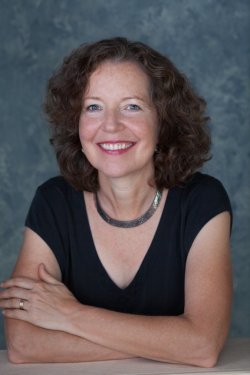
Professor, Anthropology
- Phone
- 973-655-7560
- mccaffreyk@montclair.edu
- Location
- Dickson Hall, 138
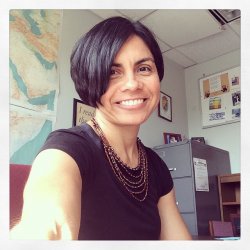
Associate Professor, History
- Phone
- 973-655-7561
- brizuelagare@montclair.edu
- Location
- Dickson Hall, 423