
Learning Options
Montclair State University’s Bachelor of Arts in Economics is available in both fully online and traditional on-campus formats, offering flexibility tailored to your life, schedule, and goals. This dual-delivery approach ensures that whether you’re balancing work, family, or other commitments, you can pursue your economics degree in the way that best supports your success.
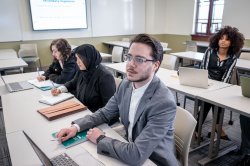
In-person students benefit from direct engagement within the vibrant Feliciano School of Business, collaborating face-to-face with faculty and classmates in a traditional campus setting.
The full-time hybrid is a mix of in person and online coursework completed in a full-time format in as few as 16 months, starting in the fall. You’ll attend some classes on campus while completing others online, allowing you to build strong connections with faculty, peers, and industry professionals while still enjoying convenience and flexibility.
Concentrations
Economics majors at Montclair can customize their degree by choosing a concentration that aligns with their career goals.
Want to know what really drives the economy — and how it affects your everyday life? The General Economics concentration covers both macroeconomics (the study of entire economies) and microeconomics (the study of choices made by individuals, households, and businesses). You’ll build strong analytical and critical thinking skills using quantitative tools, while exploring questions like: What causes recessions and inflation? Why do countries trade? How can data help us forecast market conditions and guide smarter decisions? This concentration prepares you to think strategically about complex problems and their real-world impact. With its broad focus, it’s a great pathway into careers in finance, consulting, government, nonprofits, or research, as well as graduate study or law school.
Want to learn how money grows, moves, and creates value in the global economy? The Asset Management concentration combines the fundamentals of economics with the technical tools of finance, giving you both analytical depth and practical skills for today’s financial markets. Offered in collaboration with the Accounting and Finance Department, this interdisciplinary concentration is ideal for students who want a strong grounding in economic theory while also gaining hands-on training in finance. You’ll learn how to evaluate investments, measure risk, and develop strategies for managing portfolios of financial assets. Coursework emphasizes modeling and data-driven analysis, preparing you to connect economic factors with valuation, returns, and financing decisions. Graduates are well-prepared for careers in investment management, hedge funds, commercial and investment banking, or related fields where financial expertise shapes the global economy.
Ever wonder why prices rise, why countries trade, or what causes inflation? The Economics minor gives you a solid foundation in microeconomics, macroeconomics, and data analysis, helping you understand the forces that shape today’s global economy. You’ll learn to analyze economic policies, interpret data, and connect theory to real-world issues across business, government, and society. Because economics overlaps with fields like science, social sciences, and business, this minor pairs well with almost any major. Open to students with a GPA of 2.0 or higher (except Economics majors or those in the Asset Management concentration), the Economics minor offers a flexible way to strengthen your analytical and critical thinking skills.
