
Graduate Repertoire Requirements
Your audition at the Cali School of Music is an opportunity to show us what you can do!
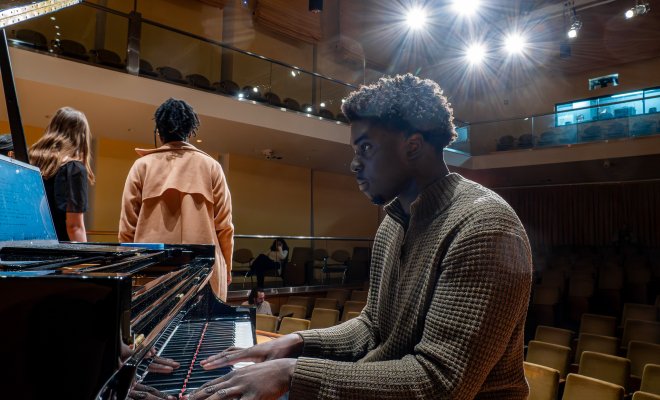
Your audition at the Cali School of Music is an opportunity to show us what you can do!
Through a formal audition, the Cali School wants to hear your current level of accomplishment, as well as your potential for growth and mastery on your instrument. Please review the requirements for your academic level and primary instrument below, choosing pieces that fulfill the requirements, are well-prepared, and that best demonstrate your abilities.
Note: Graduate Voice applicants will be required to complete a pre-screen process prior to a formal audition.
Review pre-screen requirements
All applicants who do not require a pre-screen should continue below to review the repertoire requirements.
Repertoire Requirements by Instrument
Brass
Trumpet, French Horn, Trombone, Euphonium, Baritone Horn, Tuba
- Chromatic and all major scales – prepared to play at the discretion of faculty
*video applicants should record three (3) scales: one major, one minor, one chromatic – keys of your choice - Two contrasting pieces from the standard solo repertoire (one may be an etude) totaling 10 minutes of music
- Sight-reading (live auditions only)
- A complete solo work, such as a concerto or sonata
- A contrasting solo work, solo movement, or etude
- Excerpts from the orchestra or wind band repertoire
Guitar
Classical Guitar (must audition on a nylon string guitar)
*Jazz guitarists should review the requirements listed under the Jazz Studies program
- Scale study (choose one) – Matteo Carcassi, Op. 60, no. 1 or 14
- Chord study (choose one) – Fernando Sor, Op. 31, no. 20 or 23
- Perform three pieces in contrasting styles, from memory, originally written for the classical guitar from the 19th century to the present (please – NO transcriptions).
- Sight-reading (1st, 2nd, 5th, 7th, and 9th positions)
For more information contact: Oren Fader, Coordinator of Guitar Studies: fadero@montclair.edu
Harp
- An etude of your choice (Rolscha, Pizoli, Salzedo)
- Two pieces from the concert repertoire in contrasting style (e.g. Naderman or Krumpholtz: Sonatas; Grandjany: Two French Folksongs; Pratt: Little Fountain)
- Sight-reading
- An etude of your choice (Rolscha, Pizoli, Salzedo)
- Two pieces from the concert repertoire in contrasting style (e.g. Naderman or Krumpholtz: Sonatas; Grandjany: Two French Folksongs; Pratt: Little Fountain)
- One additional piece from the concert repertoire, 20 minutes of music, total, from memory
- Sight-reading
Piano/Keyboard
Music MA, Theory and Composition Concentrations
Candidates must prepare three (3) pieces total, chosen from list A, B, C, or D below. You may only choose one piece from each list, meaning you cannot choose two pieces from the same list. One of your three pieces must be memorized.
Performance MM & Artist's Diploma
Candidates must prepare four (4) pieces, one each from Lists A, B, C, and D. Selections must be significant works from the repertoire, suitable for a graduate-level recital. All four pieces must be memorized. Candidates will also be expected to sight-read at the audition.
Piano Repertoire List
- LIST A Bach, J.S.; Rameau; Scarlatti; Soler; or another Baroque composer
- LIST B Beethoven; Haydn; Mozart; or another Classical composer
- LIST C Brahms; Chopin; Liszt; Mendelssohn; Rachmaninoff; Schubert; Schumann; or another Romantic composer
- LIST D Bartók; Copland; Debussy; Fauré; Granados; Kabalevsky; Poulenc; Prokofiev; Ravel; Scriabin; Stravinsky; Tcherepnin, A.; Villa Lobos; or another composer born since 1874
All applicants to the organ program should prepare three pieces of repertoire from the major periods of organ composition
- One Baroque piece, ideally a major work by J.S. Bach or one of his contemporaries (ie. Prelude & Fugue)
- Two pieces by Romantic or Contemporary composers, one of which being lyrical and the other virtuosic.
- Additionally, the applicant should prepare a hymn as if one were playing for an assembly. The hymn should include all stanzas preceded by an introduction.
A short diagnostic keyboard skills exam will also be conducted.
Any questions may be directed to Prof. John Miller at this email address: millerjoh@montclair.edu.
Music MA, Theory and Composition Concentrations
- Candidates must prepare three (3) pieces total, chosen from list A, B, C, or D below. You may only choose one piece from each list, meaning you cannot choose two pieces from the same list. One of your three pieces must be memorized. Candidates will also be expected to sight read or realize a figured bass.
Performance MM & Artist's Diploma
- Candidates must prepare four (4) pieces, one each from Lists A, B, C, and D. One piece must be memorized. Candidates will also be expected to sight-read or realize a figured bass at the audition.
Harpsichord Repertoire List
- LIST A Couperin, F.; Couperin, L.; Rameau; Rebel; or another French composer
- LIST B Froberger; Bach, J.S.; Bach, C.P.E.; Sweelinck; or another German or Flemish composer
- LIST C Scarlatti; Pasquini; Soler; Coelho; or another Italian or Iberian composer
- LIST D Gibbons; Byrd; Bach, J.C.; Blow; or another English composer
Percussion
All auditionees are required to perform:
- An etude demonstrating the highest personal level of proficiency in each of the three areas of study: Snare Drum, Timpani, and Mallet Percussion (marimba, xylophone or vibraphone). Mallet Percussion solo can be for two or four mallets.
- Two orchestral excerpts on each of the following instruments
- Snare Drum
- Timpani
- Xylophone
- Orchestra Bells
- Tambourine
- Triangle
- Crash Cymbals
- Bass Drum
Some audition repertoire suggestions include:
- Snare Drum
- Anthony Cirone Portraits in Rhythm
- Jacques Delecluse 12 Etudes or Keiskleiriana 1 or 2
- Timpani
- Saul Goodman Method Book Etudes
- Jacques Delecluse 20 Etudes
- Elliot Carter 8 Pieces for Timpani
- Mallet Percussion
- Morris Goldenberg Modern Method for Xylophone Etudes
- J. S. Bach Sonatas and Partitas for Violin or Cello Suites
- G. F. Handel Sonatas
- Two contrasting solo pieces, at least 10 minutes of music, in each of the three areas of study: Snare Drum, Timpani, and Mallet Percussion (marimba, xylophone or vibraphone). Mallet Percussion solos must include one four-mallet solo and would be best to include one four-mallet and one two-mallet solo.
- Two orchestral excerpts on each of the following instruments
- Snare Drum
- Timpani
- Xylophone
- Orchestra Bells
- Tambourine
- Triangle
- Crash Cymbals
- Bass Drum
Some audition repertoire suggestions include:
- Snare Drum
- Anthony Cirone Portraits in Rhythm
- Jacques Delecluse 12 Etudes or Keiskleiriana 1 or 2
- Timpani
- Saul Goodman Method Book Etudes
- Jacques Delecluse 20 Etudes
- Elliot Carter 8 Pieces for Timpani
- Mallet Percussion
- Morris Goldenberg Modern Method for Xylophone Etudes
- J. S. Bach Sonatas and Partitas for Violin or Cello Suites
- G. F. Handel Sonatas
Strings
Repertoire applies to all concentrations & Artist’s Diploma
- Two (2) scales — one major and one minor — with corresponding arpeggios, 3 octaves (memorized is preferred but not required)
- One (1) concerto from the standard violin repertoire — first movement with cadenza (memorized is preferred but not required)
- Two (2) contrasting movements from a solo Bach Sonata or Partita
- One (1) virtuosic piece (example: Paganini Caprice or similar equivalent)
- One (1) technical etude of your choice (examples: Kreutzer, Rode, Dont, Gavinies, Paganini, or similar equivalent)
- Two (2) contrasting movements of a Bach Cello Suite
- One (1) movement of a concerto from the standard viola repertoire, or a suitable equivalent
- One (1) etude or short work of the applicant’s choice (example: a contemporary work, or a piece that showcases the applicant’s technical abilities)
- Two (2) contrasting movements of a Bach Cello Suite
- One (1) movement of a concerto from the standard cello repertoire, or a suitable equivalent
- One (1) etude or short work of the applicant’s choice (example: a contemporary work, or a piece that showcases the applicant’s technical abilities)
- One (1) scale, major or minor, with corresponding arpeggios — 3 octaves
- Two (2) movements of a concerto from the standard repertoire — must be the 1st and 2nd movement of the chosen work (examples: Dittersdorf, Vanhal, Bottesini, Koussevitzky, or similar equivalent)
- Two (2) orchestral excerpts from the standard repertoire — choices must represent different eras
Woodwinds
Flute, Oboe, Clarinet, Bassoon, Saxophone
- Chromatic and all major scales
- Live Auditions – applicants may be asked to play any combination of scales chosen by faculty
- Video Auditions – applicants should record three (3) scales: one major, one harmonic minor, one chromatic
- Two contrasting pieces from the standard solo repertoire (one may be an etude) totaling 10 minutes of music
- Possible sight-reading
This degree is set up for a combination of the following instruments: flute, clarinet, saxophone, oboe, bassoon. Students are required to audition on a minimum of 3 out of the 5 instruments offered within the program. Students may opt to include a 4th instrument on their audition if they choose.
Including a double reed in your audition is not required, but it is strongly encouraged.
The audition will be a total of 15-20 minutes with the following requirements:
- Primary Instrument (5 minutes): All scales – major, harmonic minor and chromatic (at faculty discretion). One etude & one movement of any major sonata or concerto.
- Secondary Instrument (5 minutes): All major & chromatic scales (at faculty discretion). One etude & one movement of any major sonata or concerto.
- Third Instrument (3 minutes): One etude – OR – a movement of any major sonata or concerto.
- Fourth Instrument (3 minutes): One etude – OR – a movement of any major sonata or concerto.
- Possible sight-reading on all instruments
- All Scales
- Live Auditions – applicants may be asked to play any combination of scales chosen by faculty
- Video Auditions – applicants should record three (3) scales: one major, one harmonic minor, one chromatic
- One complete solo work, such as a concerto or sonata
- One contrasting solo work – i.e. one solo movement, or etude
- Two (2) excerpts from the standard orchestra or wind band repertoire
- Possible sight-reading
Voice
The repertoire below will be used for both the pre-screen requirements, as well as the invited, formal audition. Please be sure to review the pre-screen information in full to best prepare.
All audition pieces must be memorized. An accompanist will be provided for applicants who are completing a live, formal audition. Please bring paper copies of your sheet music to provide for the accompanist.
Three (3) pieces chosen from the solo voice literature including:
- One art song in English
- One art song in a foreign language
- One additional song or aria of the candidate’s choice from any genre or style of music that shows the candidate’s strengths
Four (4) pieces chosen from the solo voice literature including:
- One Italian aria or art song
- One German or French art song
- One 20th or 21st century aria or art song in English
- One additional selection of the candidate’s choice. May be in any language, style, or genre that shows the candidate’s strengths
Five (5) pieces chosen from the solo voice literature including:
- At least four pieces must be from the standard operatic, art song, and/or oratorio repertoire.
- Candidates must perform at least one selection each in Italian, French, German, and English.
- A variety of styles, periods, and tempos should be presented.
- At least two pieces must be operatic arias.
- A fifth selection may be of the candidate’s choice in any language, style or musical tradition (i.e. spiritual, American Song Book, contemporary classical, operetta, Zarzuela, musical theater, native language art song or aria, etc.)
Jazz Studies
Applicants who choose to submit audition videos may record with a backing track, live musicians, or without accompaniment.
Applicants who choose to audition live will be provided with musicians from the Cali School. Please bring three (3) copies of sheet music to your audition.
Repertoire – Scat singing (vocal improvisation) is encouraged but not required. All melodies should be sung with your own interpretation, but using the correct pitches.
- One (1) song from the Great American Songbook (Rodgers & Hart, Gershwin, Cole Porter, Irving Berlin, etc.)
- Sung in a swing feel, at a medium or medium-up tempo
- Please sing three choruses with improvisation or an embellished melody on the second chorus.
- One (1) jazz ballad
- One (1) of the following:
- A blues song in a jazz/swing feel, performed at medium tempo. Please include 2-3 choruses of improvisation or embellished melody.
- A song with a straight-eighth feel – Latin, Samba, or Bossa Nova. Please improvise or sing an embellished version of the melody on the second chorus.
- A song that exhibits your unique musical personality (such as a contrasting genre or an original composition)
- One (1) jazz standard or blues, played at a medium tempo
- If selecting jazz standard: 1 chorus of melody, 2 choruses of improvisation.
- If selecting blues: 2 choruses of melody, 4 choruses of improvisation.
- One (1) jazz ballad with an improvised chorus
- One (1) of the following:
- An up-tempo song (quarter note = 250bpm or faster) – minimum of 2 improvised choruses
- A song with straight-eighth feel (Latin, Bossa Nova, ECM) – minimum of 1 improvised chorus
- A song that exhibits your unique musical personality (such as a contrasting genre or an original composition)
- One (1) jazz standard or blues, played at a medium tempo
- If selecting jazz standard: 1 chorus of comping, 2 choruses of improvisation.
- If selecting blues: 2 choruses of comping, 4 choruses of improvisation.
- One (1) solo version of a jazz ballad (chorded melody)
- One (1) of the following:
- An up-tempo song (quarter note = 250bpm or faster) – minimum of 2 improvised choruses
- A song with straight-eighth feel (Latin, Bossa Nova, ECM) – minimum of 1 improvised chorus
- A song that exhibits your unique musical personality (such as a contrasting genre or an original composition)
- One (1) jazz standard or blues, played at a medium tempo
- If selecting jazz standard: 1 chorus of melody, 1 choruses of walking bass, 2 choruses of improvisation.
- If selecting blues: 2 choruses of melody, 2 choruses of walking bass, 4 choruses of improvisation.
- One (1) jazz ballad – please include an improvised chorus
- One (1) of the following:
- An up-tempo song (quarter note = 250bpm or faster) – minimum of 1 improvised choruses
- A song with straight-eighth feel (Latin, Bossa Nova, ECM) – minimum of 1 improvised chorus
- A song that exhibits your unique musical personality (such as a contrasting genre or an original composition)
Acoustic Bass applicants only – an additional short classical etude that demonstrates your ability to play pizzicato & arco
- One (1) jazz standard or blues, played at a medium tempo
- If selecting jazz standard: 1 chorus of melody, 1 chorus of comping, 2 choruses of improvisation.
- If selecting blues: 2 choruses of melody, 2 choruses of comping, 4 choruses of improvisation.
- One (1) jazz ballad with an improvised chorus – please play unaccompanied for a portion of the performance
- One (1) of the following:
- An up-tempo song (quarter note = 250bpm or faster) – minimum of 2 improvised choruses
- A song with straight-eighth feel (Latin, Bossa Nova, ECM) – minimum of 1 improvised chorus
- A song that exhibits your unique musical personality (such as a contrasting genre or an original composition)
- One (1) jazz standard or blues, played at a medium tempo:
- If selecting jazz standard: 1 chorus of melody, 1 chorus of comping, 2 choruses of improvisation.
- If selecting blues: 2 choruses of melody, 2 choruses of comping, 4 choruses of improvisation.
- One (1) jazz ballad with an improvised chorus – please play unaccompanied for a portion of the performance
- One (1) of the following:
- An up-tempo song (quarter note = 250bpm or faster) – minimum of 2 improvised choruses
- A song with straight-eighth feel (Latin, Bossa Nova, ECM) – minimum of 1 improvised chorus
- A song that exhibits your unique musical personality (such as a contrasting genre or an original composition
- One (1) medium-temp song. Please include:
- 1 chorus of playing time and comping behind a soloist (2 choruses if you select a blues)
- 1 chorus of an improvised drum solo (2 choruses if you select a blues)
- One (1) up-tempo song (quarter note = 250bpm or faster). Please include:
- 2 choruses of playing time and comping behind a soloist
- 2 choruses of trading eighths
- One (1) of the following:
- A jazz ballad demonstrating the ability to play with brushes
- A song with straight-eighth feel (Latin, Bossa Nova, ECM)
- A song that exhibits your unique musical personality (such as a contrasting genre or an original composition)
Questions about Auditions?
- John J. Cali School of Music
- Telephone 973-655-7212
- Address Chapin Hall
Coordinator of Music Admissions & Recruitment
Linsay Setzer
- setzerl@montclair.edu
- Telephone 973-655-7212
- Address Chapin Hall, Main Office Room 144