
Emergency Medical Services

Rapid response, quality care. When emergencies happen, you’re not on your own. Montclair Emergency Medical Services (EMS) is here 24/7 with trained student EMTs ready to respond, support, and care for our campus community.
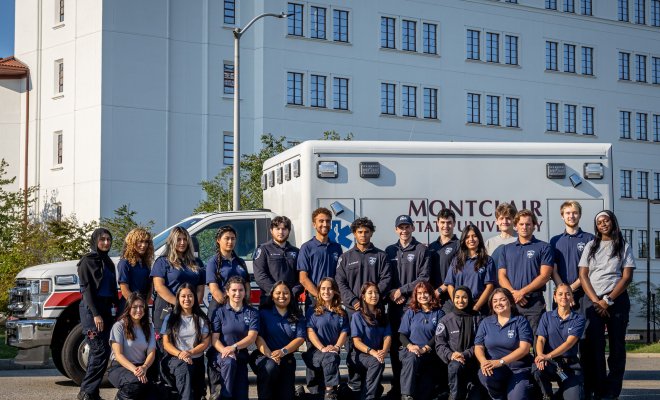
Group of EMS students in front of an ambulance with Montclair State University on the side of the truck.

Student-Led Emergency Care 

Montclair State University Emergency Medical Services (EMS) is a volunteer, student-run organization that’s been serving campus since 1998. 

Staffed by certified Emergency Medical Technicians (EMTs) and CPR-trained members, EMS provides basic life support, emergency medical care and ambulance transportation to local hospitals. 

Because we believe in removing barriers to support for the campus community, our EMS services and transports to local hospitals are provided at no cost.

What Services Does EMS Provide to Campus?

Montclair EMS is well-trained and equipped to handle basic emergencies that occur both on and off campus, including (but not limited to):

  • Strains, sprains, and breaks
  • Head injuries
  • Medical emergencies such as chest pain, seizures, allergic reactions and anaphylaxis, difficulty breathing
  • Mental health emergencies 

Should an emergency require advanced treatment, EMS is able to call additional assistance from the paramedics in our area.

Our mission is to advance the well-being of the communities we serve. Beyond emergency response, EMS also plays a major role in campus wellness, offering CPR and First Aid training for students and the surrounding community. Groups may also request that EMS be present for standby services at large events, or events where there is an increased risk of injury or illness such as  sporting events, carnivals and concerts.

Life-Saving Tools on Campus

Help is never far away. Automated External Defibrillators (AEDs) are located in all major campus buildings, making rapid response possible during cardiac emergencies. Many AED cabinets also include Narcan kits, providing immediate access to naloxone in the event of an opioid overdose.

Resident EMT Program

Our Resident EMT Program helps keep campus even safer during nights and weekends by placing trained EMTs right where students live. 

Selected resident EMTs commit to on-call shifts throughout the week and month, increasing response availability during high-need hours. In exchange, they receive a housing waiver and live in designated EMT apartments..

CPR & First Aid Training

Learn life-saving skills. We offer a range of American Heart Association–certified courses designed for everyone, from beginners to healthcare professionals. 

Training options include CPR/AED for adults, children, and infants; First Aid certification; Basic Life Support (BLS) and refresher courses; Narcan and overdose awareness; and Stop the Bleed training. 

Whether it’s for a job requirement or peace of mind, these classes help you show up prepared.

Frequently Asked Questions

Operations and Transport

During the fall and spring semesters, Montclair State EMS is available 24/7 with the exception of holiday breaks (Thanksgiving, winter/spring break). Over the summer semester, Montclair State EMS is available Monday-Friday from 7 a.m to 7 p.m., with the occasional overnight. Should Montclair State EMS not be available, the campus still has emergency medical coverage through the agreement with local mutual aid agencies that will be dispatched and respond to campus emergencies.

With the exception of a few special cases, Montclair State EMS transports to the closest hospital with the most appropriate interventions available. We primarily transport to St. Joseph’s Medical Center in Paterson and Hackensack Meridian Health at Mountainside Hospital in Montclair. For traumatic injuries, we transport to St. Joseph’s, a designated Level II Trauma Center. Psychiatric emergencies are transported to Mountainside Hospital as they work with our University Counseling And Psychological Services (CAPS) department to ensure continued care. Should your condition warrant transfer to another hospital after arriving in an emergency, the hospital will arrange for hospital transfers.

Montclair State EMS carries EMERGENCY medications including, Naloxone (Narcan), glucose, aspirin (for cardiac emergencies), epinephrine (for severe allergic reactions), and oxygen.

We DO NOT carry every day medications for non-emergencies such as Benadryl, Tylenol, Advil, cough drops/medication, Midol, or other over the counter medications. These medications may be found at the University Health Center or the C-Store on campus.

From a campus phone, you can dial x5222 or 973-655-5222 which will connect you to the campus police department who will get an ambulance dispatched. If you cannot get to a campus phone, you can call 911 or 973-655-5222 from any phone, just make sure you are telling the dispatcher your location and remember to stay on the phone until you are instructed to hang up.

The University Health Center is available for students who wish to receive medical treatment. The UHC in a comprehensive outpatient health care facility that provides multiple services including physicals, gynecological care, STD/HIV screening, referrals, diagnosis/treatment of illness and injuries, laboratory services, immunizations, emergency contraceptives, and more.

Unfortunately, no. As an EMS agency we are able to transport to hospitals only. We do not provide transportation back to campus once you have been discharged, but the hospital may be able to assist you in finding a means of transportation from the hospital to campus.

In any situation where there is a medical emergency, 911 should be contacted immediately. Montclair State University has adopted a Medical Amnesty Policy that seeks to remove barriers to calling 911 in situations where alcohol/drugs may be involved.  Students who seek emergency medical attention for themselves or for whom medical assistance was sought related to consumption of alcohol and/or other drugs will not be charged with violations of the Montclair State University Code of Conduct associated with that consumption (specifically: Section II, Letter B.), provided they comply with specific conditions.

Cost and Billing

No. We do not charge for services that we provide as a Basic Life Support ambulance nor for the transport to local hospitals.

You may receive a bill after being transported due to a few reasons:

  • If Montclair State EMS is not available due to being on a call already or out of service, agreements are set up with neighboring towns to assist us with mutual aid so that all calls for emergencies are answered. These departments may charge for their services. The most common ones on campus are Little Falls EMS and Montclair EMS.
  • Your level of emergency required the utilization of paramedics, or an Advanced Life Support (ALS) unit. The paramedics provide a higher level of medical intervention and do charge for their services.
  • You may receive a bill from the hospital or be required to pay for treatment at the hospital, depending on your personal insurance.

While Montclair State EMS does its best to answer every emergency call on campus, there are times when that is not possible. In all of the above situations, Montclair State EMS has no control over the billing processes of other agencies. If you receive a bill and need assistance, contact the billing department and they would be able to assist you or work with your insurance provider, if ambulance services are covered.

Working with EMS

Absolutely! We are always looking for new members to join our department. You do not have to be EMT certified when you join. We require a minimum of a Healthcare Provider level CPR/AED certification, which we may be able to help you obtain if you intend to join the department. For all information related to membership with the department, please visit EMS on Inside Montclair. Questions can be directed to our officers at ems@montclair.edu or at the EMS office in Student Center Rm. 209

  • EMT training classes are offered throughout the state of NJ. Learn More and Find a Class Near You.
  • The EMT course is approximately 200 in-class hours in addition to an asynchronous component. Students are encouraged to take this course over the Summer instead of simultaneously with a full college course load.
  • The course typically costs approximately $1,500, not including class materials and books.
  • The State of NJ offers a training fund payment voucher for members of eligible volunteer EMS squads, with the expectation of a minimum of one full year of volunteer service after completing the course. 
  • Montclair State University EMS considers providing payment vouchers on a case-by-case basis after successful completion of our in-house training program. Students are encouraged to find a volunteer squad near their hometown to cover the cost of the course.

No, we are a volunteer agency with the exception of occasional paid opportunities for covering special events.

We have a limited number of spots for members who are eligible for our competitive Resident EMT Program.

AED Information

Montclair State University recently installed Automated External Defibrillators (AEDs) in all of its main campus buildings. These AEDs are used in emergencies when someone does not have a pulse and is not breathing. AEDs are used to correct electrical problems in the heart.

Narcan/Overdose Awareness

Opioid abuse is a growing public health crisis and the leading cause of accidental death in the United States. It is important for all of us to be aware of the signs and symptoms of opioid abuse and overdose, as well as to understand how to properly administer naloxone.

Naloxone (Narcan) is a safe and effective medication used to reverse the effects of an opioid overdose and can be given by anyone with proper training. The FDA recently approved over the counter use and distribution for this life saving, non habit-forming medicine.

To support this effort, Montclair State University Emergency Medical Services (EMS) has installed naloxone kits supplied by the New Jersey Department of Health in the AED cabinets across campus, which are located in highly visible areas such as academic buildings, residence halls and administrative offices. University Police and EMT’s currently also carry naloxone kits.

Information and Resources on Narcan

Have Questions? We’re Here To Help!