
Finding Direction: How Matteo Guzman Turned Curiosity into First Place at Science Slam
When Matteo transferred to the University in the spring of last year, he wasn’t starting over, he was refining his direction
Posted in: Awards & Recognition, Chemistry & Biochemistry, CSAM Research, CSAM Students
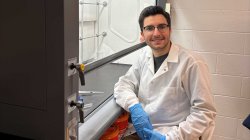
Matteo got his start at Northeastern University, as a physics major. He was drawn to particle physics and the mysteries of quantum research, but as he dove deeper into the field, he realized something was missing.
That desire led him to biology so after leaving Northeastern, Matteo worked as a technician in a DNA sequencing lab, gaining real-world experience before returning to community college and ultimately transferring to Montclair to pursue molecular biochemistry.
I love that you can study the fundamental mechanisms of life. You can zoom in to the molecular level and also see how those mechanisms affect entire systems.
Now working in Professor Eli Lee’s lab, Matteo studies protein condensates — dynamic, fluid structures formed when proteins separate from their surrounding solution, similar to oil separating from water. These condensates form through weak interactions between proteins, constantly assembling and disassembling.
His research asks a deceptively simple question: How does protein structure affect the properties of these condensates?
Understanding this process may help scientists uncover how cells transport membrane proteins and how lipid “rafts” may form around specific sites in the cell membrane. It’s a complex system — always in equilibrium, constantly shifting — and Matteo is fascinated by its elegance.
His work will take him far beyond campus. This year, he will present at the Biophysical Society Annual Meeting in San Francisco and at the American Society for Biochemistry and Molecular Biology conference in Washington, D.C.
Looking ahead, Matteo plans to pursue a Ph.D., with long-term interests in origin-of-life research, exploring how chemistry first gave rise to living systems.
“I’ve worked in industry, and it’s great for building technical skills,” he says. “But I want to work toward big, long-term scientific questions.”
Last year, Matteo took first place at Montclair’s Science Slam — not by listing data points or presenting dense slides, but by telling a story.
Science Slam challenges students to communicate their science stories in an engaging, and accessible way. For Matteo, it was transformative.
“In lab reports, you just present the facts,” he says. “But Science Slam taught me that people understand stories better than lists of information. Science communication needs narrative.”
His winning presentation centered on a hummingbird that migrates from New Jersey to the Dominican Republic for the winter — a rare but real phenomenon. The story unfolded from the hummingbird’s perspective, guided across the ocean by a protein in its eyes that detects Earth’s magnetic field.
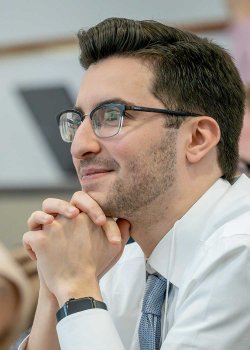
Matteo watching as his classmates give their slam presentations
Unable to see land but knowing exactly where to go, the bird eventually arrives in the Dominican Republic, landing beside Matteo and his grandmother.
The metaphor mirrored his own visits to family from New Jersey to the Dominican Republic and connected deeply with audiences.
“Science isn’t just logic,” he reflects. “There’s an emotional component. We’re not just calculators. If you want people to care about science, you have to make it compelling.”
He credits the experience with strengthening his graduate school applications and helping him learn how to frame his research as a cohesive scientific narrative.
Having attended multiple institutions, Matteo says Montclair stands out.
“It’s a place where opportunities feel within reach,” he says. “People know you. Professors and administrators are responsive. They advocate for you.”
He points especially to Montclair’s Summer Research Program, where students immerse themselves full-time in research, live on campus, and engage in professional development while presenting their work to peers.
“You’re doing research all day! It’s like a full-time job, but it’s so fun,” he says. “It’s a no-brainer opportunity.”
His advice to other students?
“Take every opportunity and see what sticks.”
Don’t Miss This Year’s Science Slam
Inspired by Matteo’s story? You can experience Science Slam for yourself on Monday, February 23rd, from 3–5 p.m. Whether you’re a student considering competing, a future scientist refining your communication skills, or simply someone who loves a good story, Science Slam is your chance to see research come alive.