How Montclair’s 4+1 Program Turned My Childhood Science Project into Real Marine Biology Research
At Montclair State University, the combined BS/MS in Marine Biology and Coastal Sciences helped Kelly Witters turn a third-grade horseshoe crab project into hands-on research for coastal conservation
Posted in: Biology, CSAM Students, Marine Biology
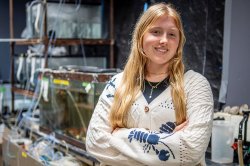
As a third grader, Kelly Witters ’26 built a sandy-beach trifold and a glass of “ocean” for a school project on horseshoe crabs – and never let them go. Today, as a graduate student in Montclair’s 4+1 (combined BS/MS) program in Marine Biology and Coastal Sciences, she has turned that early curiosity into a multiyear project on where and how horseshoe crabs spawn in Barnegat Bay, work that is helping scientists better protect both the shorebirds that depend on their eggs and the habitats horseshoe crabs need to survive.
“These shorebirds are important, but it’s just as important to know which areas need to be monitored and protected to support the horseshoe crabs,” Witters says. “If we lose the habitat and areas they use to breed and lay eggs, it will be hard to get that habitat back and keep the populations sustained.”
As a nationally recognized high-research university, Montclair State University gives students early access to faculty-led projects, which allowed Witters to join a lab in her first year and keep building her research skills in one continuous five-year path.
That early start is built into Montclair’s academic model: Montclair offers more combined programs than any other institution in New Jersey, giving students a head start on graduate study and careers. For Witters, that has meant not just upper-level science courses, but real ownership of a research question and presenting her findings at scientific conferences.