Being Multilingual is My Superpower: A Celebration of Language, Identity, and Community
Posted in: Anthropology, CLaSE, Homepage News and Events, Linguistics, Spanish and Latino Studies, World Languages and Cultures, Writing Studies
On February 18, Montclair State University came alive with voices from around the world as we celebrated International Mother Language Day 2026 under the theme: “Being Multilingual is My Superpower.”
This milestone event, the first IMLD celebration at this scale on campus, was led by Antonella Calarota-Ninman and Maisa Taha and brought together more than a dozen units across campus and beyond, reflecting an extraordinary level of collaboration and shared commitment to multilingualism.
Participating departments, centers, and offices included: CLaSE (Center for Latino Heritage and Spanish Language Excellence), Anthropology, Linguistics, Spanish & Latino Studies, World Languages & Cultures, NJCIJ (New Jersey Center for Indigenous Justice), Writing Studies, the Office of Global Engagement, the Office of Inclusive Excellence, the Office for Hispanic Initiatives, and Sprague Library.
The event also featured strong participation from international students and student organizations, including MASA, PASO, LASO, ESA, and NAIS, whose engagement contributed to the dynamic and inclusive atmosphere of the day.
With over 300 attendees, including students, staff, faculty, and members of Indigenous groups from Latin America and Native American communities, this event became a vibrant testament to the linguistic and cultural richness that defines our campus and surrounding areas.
The First Floor Reading Room of Sprague Library was transformed into an immersive, global experience where participants “traveled” across languages. Each attendee received a “language passport”, guiding them through a journey across more than twenty interactive tables, each representing a different language and cultural context or perspective. As they moved from table to table, they collected stamps or stickers while engaging in activities that celebrated language as a living, dynamic force.
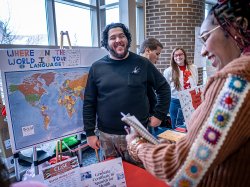
Students explored language through creativity, play, and reflection. They became “Vocabulary Detectives,” shared regional expressions at the “Teach Us Your Dialect” table, and connected through challenges like “Language Mapping” and “Translation Challenges”. At other tables, they mapped their linguistic identities, contributed to a “Word Wall”, and responded to prompts such as “Tell Us in Your Language” and “Where in the World Is Your Language?”
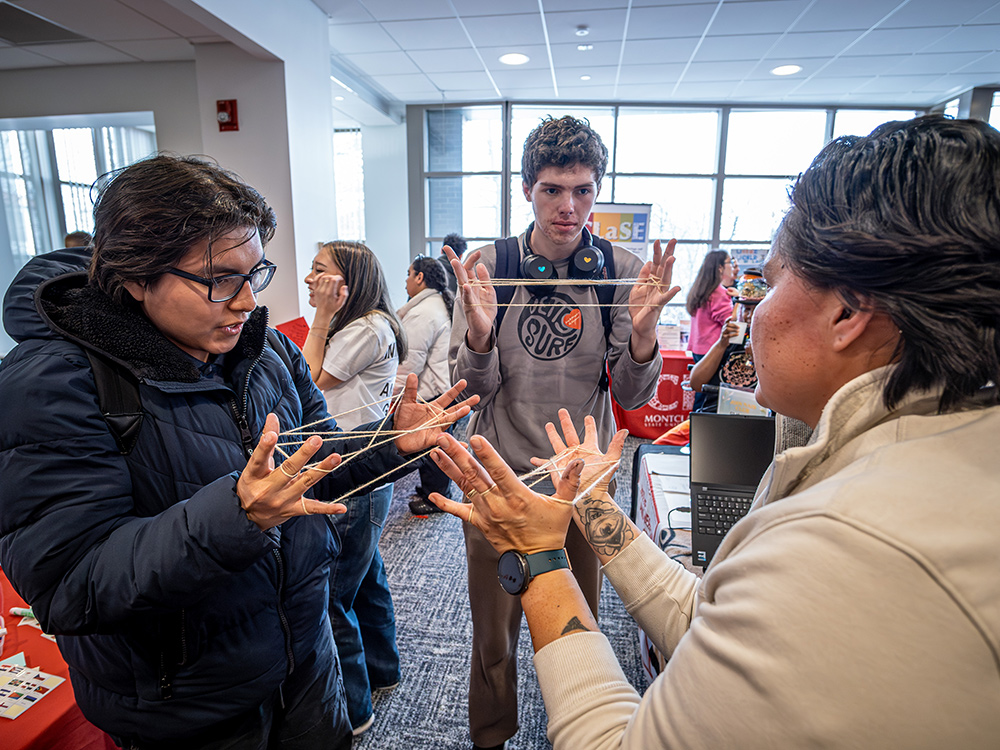
Hands-on cultural experiences added depth and beauty to the event. Participants practiced Chinese calligraphy, learned to write their names in Korean, and explored basic expressions in French and Mazahua. They also engaged with global Indigenous cultures through interactive Kichwa language guessing activities and the Navajo String Game.
Other stations invited deeper reflection on language as identity and future. Through activities including “Language Futures Survey”, “Words of Wisdom”, and the “Latin American Slang Wall -¿Cómo se dice?”, we celebrated the emotional and cultural connections embedded in language.
A highlight of the event was the series of four lightning panels, which brought powerful voices and perspectives into the room. These included presentations by Dr. Jesse Ha (Teaching & Learning), Librarian Catherine Oliver, Verónica Muenala, Próspero Martinez and Elías Hilario Guzmán (members of the Concejo de Pueblos Originarios), Precious Benally (Director of NJCIJ), and three outstanding students, Alondra Molina, Sofia Andersen Garreffa and Kaung Hla Zan. Presenters provided deeply moving personal reflections and scholarly insights, reminding us of the individual, cultural, and political significance of language in people’s lives.
The event also created meaningful bridges across time and tradition. Participants read graffiti from the ancient world and engaged with Indigenous languages and knowledge systems, reminding us that language is not only communication, but memory, resistance, and continuity.
Throughout the room, there was laughter, curiosity, and a powerful sense of belonging. Languages were spoken and celebrated, not as barriers, but as bridges. The presence of President Koppell, who joined the celebration and expressed appreciation for the energy and vibrant participation of attendees further underscored the importance of this collective moment.
This celebration was more than an event. It was a living expression of what it means to be part of a multilingual, multicultural campus space where every language is recognized as a source of strength.
See you next year!
Dr. Maisa Taha and Dr. Antonella Calarota-Ninman