Learning Beyond the Classroom: Students Engage with Indigenous Communities in Wisconsin
Posted in: Anthropology, Homepage News and Events, Native American and Indigenous Studies, New Jersey Center for Indigenous Justice, Religion
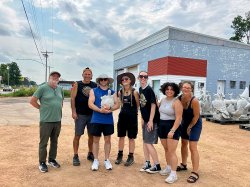
Last summer, a group of Montclair State University students and faculty traveled to Wisconsin to step beyond the classroom and into spaces where Indigenous knowledge is not only studied, but lived. Through conversations with community members, visits to culturally significant sites and time spent observing environmental and cultural practices, the experience offered a deeper understanding of Indigenous approaches to community, land and justice.
The trip brought four students in the Native American and Indigenous Studies (NAIS) program to the Stockbridge-Munsee Community Band of the Mohican Nation, where they served as volunteers and assistants for a Munsee and Mohican Language and Culture Camp. Led by professors Mark Clatterbuck and Maisa Taha, the experience gave students the opportunity to engage directly with a living language community. This experience deepened a three-year collaboration with Nikole Pecore, a language keeper whose ancestral languages are rooted in the homelands of the Mid-Atlantic and Northeast, and who has been a core collaborator with NAIS since its inception.
The trip was part of a broader effort to expand Montclair’s NAIS program and further the development of the New Jersey Center for Indigenous Justice through a $1 million grant from the Mellon Foundation. It also reflects the program’s commitment to immersive, community-engaged learning that connects academic study with real-world experience.
“Our Native American and Indigenous Studies (NAIS) program is not interested in hollow gestures or performative statements,” says Clatterbuck. “Rather, we’re committed to the work of Indigenous justice that’s grounded in relationship building and reciprocity with tribal communities.”
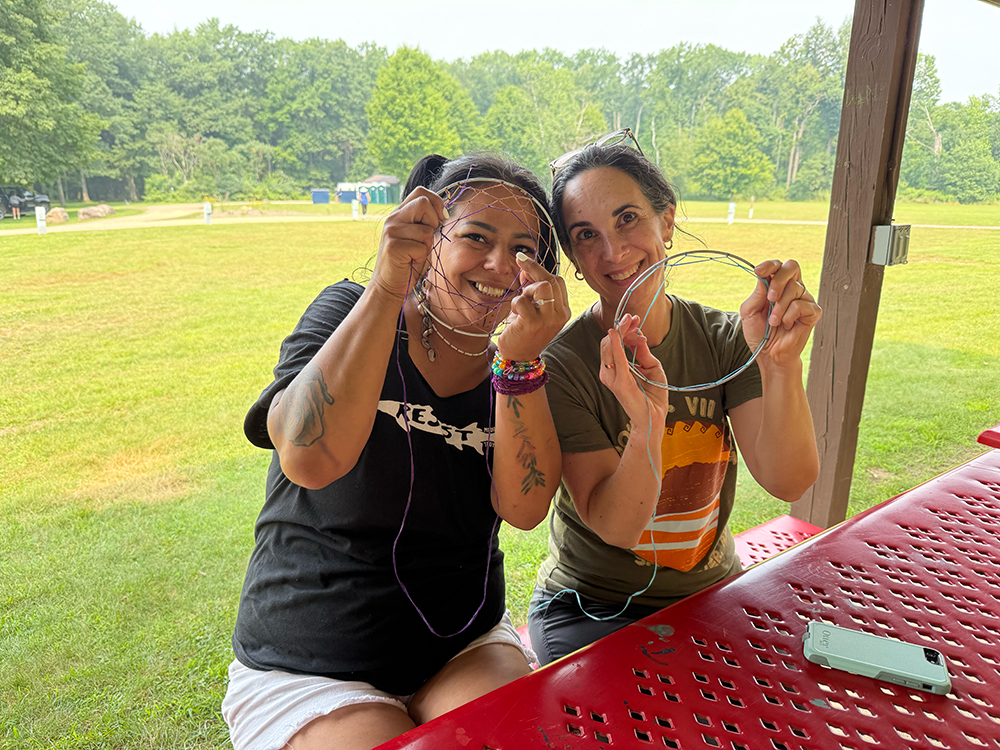
Throughout the trip, students were welcomed into intergenerational community spaces where learning unfolded through shared meals, conversations and participation in daily cultural practices. The group camped on powwow grounds while supporting the language camp, helping to serve traditional meals and participating in activities ranging from block printmaking and dreamcatcher-making to Lenape football and lacrosse. Evenings were spent around the campfire sharing stories, while mornings began with a sunrise water ceremony.
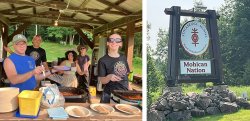
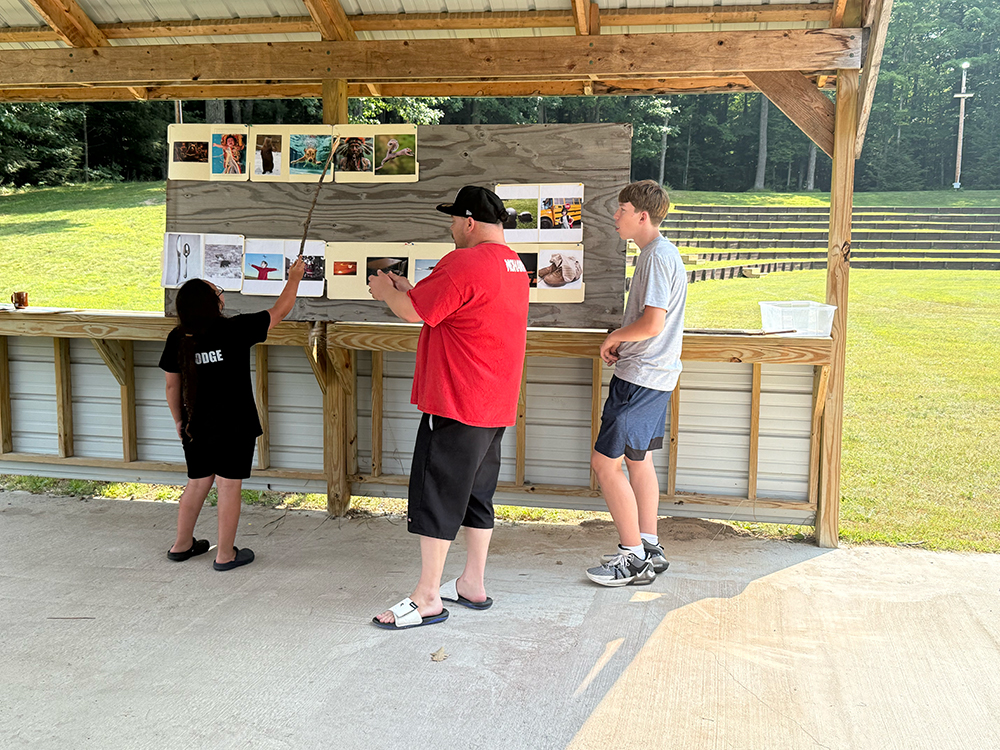
At the language camp, rather than encountering language as something abstract, students experienced it as part of a living system, connected to the medicinal plants growing on site, and woven into song, storytelling, and family connections.
“Language isn’t something you study on its own,” Taha explains. “It’s connected to ceremony, to history, to social interaction—it lives within the community.”
Learning in an intergenerational environment, surrounded by elders, families, and young people, highlighted how language is sustained through relationships and shared experience. The Stockbridge-Munsee Community is a two-language community, preserving both Munsee and Mohican languages with deep historical and cultural ties, including connections to Indigenous communities in New Jersey.
Ellie Paschalis ‘25, who will build on her NAIS minor and community-engaged experiences during graduate studies at U Mass Boston in the fall, found the trip inspiring. “It’s really a beautiful thing to see people reclaim their heritage, and to see that the language persists, and people are actively learning it,” she says. “It’s a direct act of resistance, and a huge step towards rebuilding a piece of culture that was diminished due to colonial pressures.”
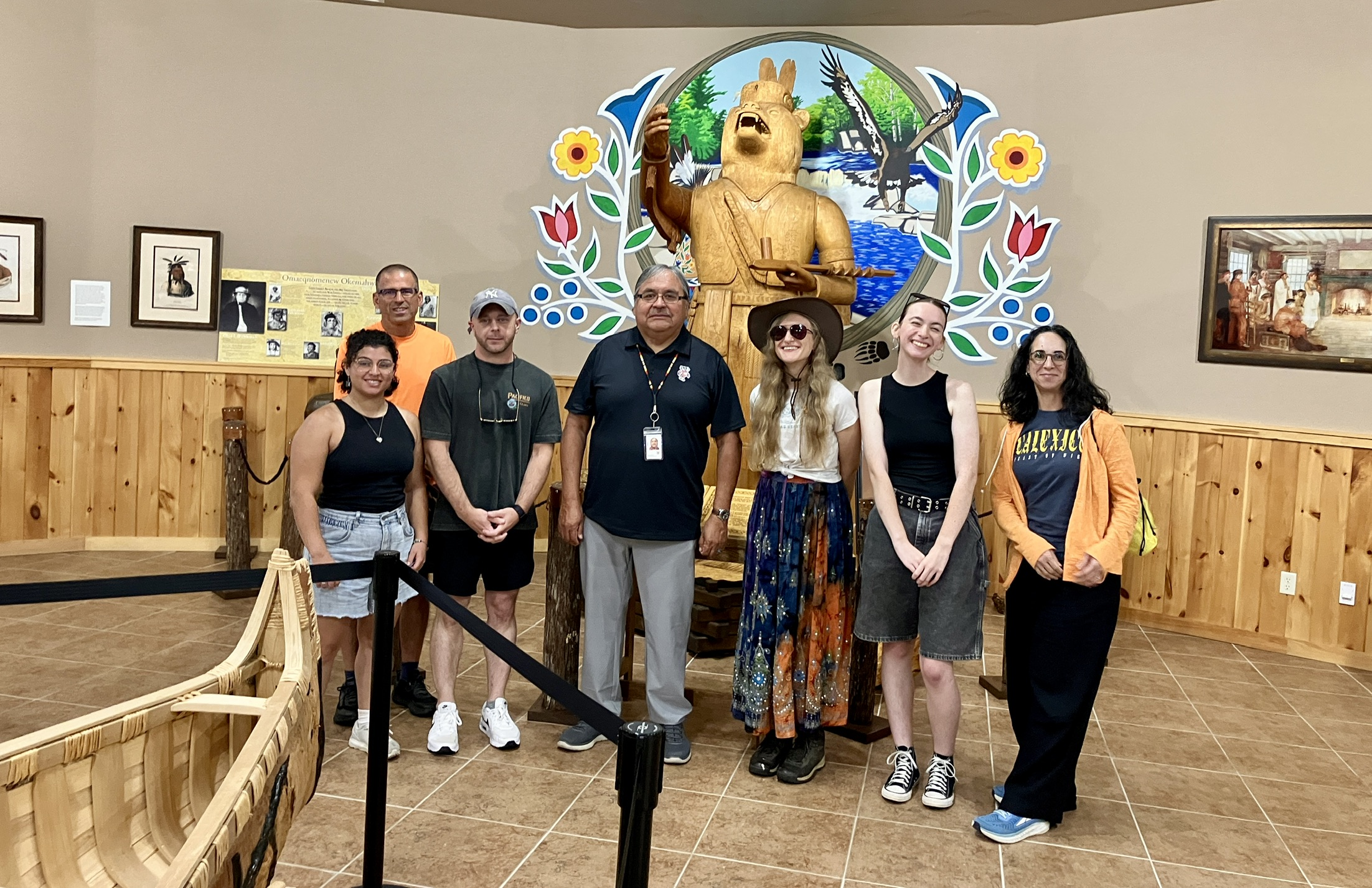
Beyond the camp, students expanded their understanding of Indigenous history and life through visits to neighboring nations, including museums and historic preservation spaces on the Menominee Nation and Oneida Nation reservations, and hiking along the Wolf River.
Taha emphasizes the importance of carrying these experiences back to campus. “This work shows up in our teaching, in our programming, and in how we think about community,” she says, noting the value of centering identity, heritage, and lived experience in the learning process.
Paschalis noted that the camp was different from any other language learning method that she had encountered before. “The strategy behind the method was one of kindness, with teachers and fellow students providing a space for students to learn without shame for making mistakes,” she says. “Teachers applauded each student for their efforts regardless of the answer, reassuring them that they would progress with time and consistency.”
The trip also builds on coursework developed at Montclair, like the Indigenous Languages and Lifeways course, which has been offered since 2022. Experiences like this extend that learning beyond the classroom, reinforcing the program’s focus on language, culture, and community as interconnected systems.
Plans are already underway for the next iteration of the trip, with a return visit to Wisconsin anticipated in Summer 2026. For students considering the experience, this program offers an opportunity to engage deeply with communities, challenge assumptions, and expand their understanding of Indigenous knowledge and justice.
“This is about learning through relationships,” Clatterbuck adds, underscoring the program’s foundation in listening, respect, and reciprocity.
Registration for the summer 2026 trip will open soon, with opportunities for students across disciplines to participate. Additional details, including program dates and application information, will be shared in the coming weeks. In the meantime, interested students are encouraged to contact Maisa Taha (taham@montclair.edu) or Mark Clatterbuck (clatterbuckm@montclair.edu) for more information.
Photo Gallery
Click on an image below to enlarge photo.
 Maisa Taha and Wanonah Spencer (Stockbridge Munsee Community Band of Mohican Indians) make dreamcatchers during cultural crafts time with campers.
 Our team at the Menominee Cultural Museum where we met with David Grignon, Tribal Historic Preservation Officer for the Menominee Nation.
 Jeremy Mohawk (Stockbridge Munsee Community) leads hands-on Munsee language lessons with young students at the Munsee & Mohican Language and Culture Camp.
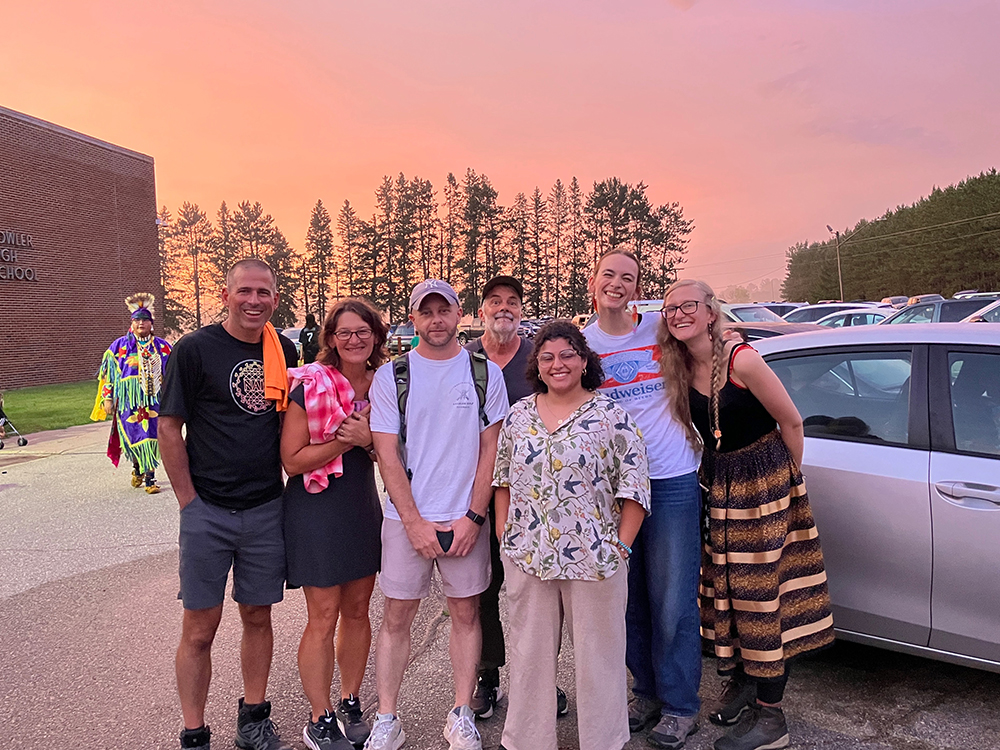
 Our team outside Bowler (WI) High School during the Annual Mohican Powwow. The powwow was forced to move indoors to the high school gymnasium due to rain.