
Mariah Ayscue’s Journey Through Community, Care and Liberation
A Gender, Sexuality, and Women’s Studies major and NAIS field school participant, Ayscue reflects on identity, scholarship and the power of being fully human.
Posted in: Gender, Sexuality, and Women's Studies, Homepage News and Events, Native American and Indigenous Studies, Student News
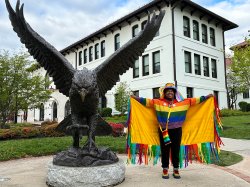
Mariah Olivia Ayscue (he/king) didn’t just choose Montclair State University—he found community here first.
Before even applying, Ayscue attended a Gender, Sexuality, and Women’s Studies (GSWS) Zine launch party on campus. “The community was beautiful,” he recalls. Already immersed in creative and activist spaces as a Black Indigenous, 2-Spirit, transgender, intersex, disabled, spoken word poet, singer and community organizer, he was drawn not only to what students were learning, but how they expressed it.
That connection shaped his academic path. As a GSWS major and participant in the Native American and Indigenous Studies (NAIS) summer field school, Ayscue built an experience rooted in both intellectual exploration and lived identity. Midway through his time at Montclair, an email about the NAIS field school sparked something deeper. “At the time, I didn’t know there was a NAIS program,” he says—but once accepted, the experience became transformative.
“The summer field school program changed my life,” Ayscue shares. Through it, he reconnected with relatives from the Ramapough Munsee Lenape Nation, relationships impacted by generations of enslavement and displacement. “Everyone in the field school was hungered for truth and justice, loving, genuine, passionate, and excited to work together.”
In the classroom, that same sense of depth and connection carried through. Courses like Feminist Theory in Transnational Context with Dr. Monica Taylor gave him space to explore anti-colonial care work across his identities, while also learning alongside peers. “Both GSWS and NAIS communities went above and beyond the ordinary classroom structure,” he says. “They allowed us to be human.”
That emphasis on humanity—on learning as something embodied, communal and deeply personal—became central to Ayscue’s academic and creative work. Faculty mentors like Taylor and Dr. Mark Clatterbuck helped shape that journey, grounding his work in intersectionality while fostering space for both joy and grief. “They know what it means to both build community and be active participants within it,” he says.
Outside the classroom, Ayscue extended that commitment through leadership roles as a GSWS Head Intern and NAIS Club event coordinator. Still, he points back to the field school as the experience he’s most proud of, alongside his research on anti-colonial care work.
As he looks ahead to pursuing a Master of Divinity at Union Theological Seminary, Ayscue remains focused on continuing that work—centering embodied theology, radical access and collective liberation.
His understanding of success is still evolving. “I’m still finding what success means outside of capitalistic expectations,” he reflects. “I just want to do what I love. And do it well.”
For students following a similar path, his message is direct and deeply personal: trust your own knowledge. “Do not put your own intelligence into question,” he says. “Your wisdom is valuable. Stay curious. And keep learning.”
This story is part of a series celebrating College of Humanities and Social Sciences Graduates.