
The Department of Theatre and Dance Welcomes International Performance “YOHAKU” to Montclair State University
Posted in: College News and Announcements, Department of Theatre and Dance News
Bringing global artistry to Montclair State University, the Department of Theatre and Dance is proud to present YOHAKU, a powerful performance whose title translates to “Empty Space” in Japanese. This unique production, brought to life by the International Exchange group of the Aichi Arts and Culture Network (ANET), offers students and community members a glimpse into Japanese theater.
Even though YOHAKU means “empty space,” it doesn’t mean something is literally empty. In Japanese art and culture, yohaku is about using quiet, simple spaces to spark imagination and reflection. Instead of using lots of bright colors or flashy lights, traditional Japanese art focuses on calmness, simplicity, and letting the audience imagine part of the story. This performance brings together past traditions with modern ideas, showing how the past and present can work together.
The program begins with a short film titled BONJI, directed by Naoko Ukibe. BONJI received international acclaim, winning both “Best Arthouse Award” and “Best Sound Edit Award” at the 2023 Monaco International Film Festival. The film uses classical cinematic techniques, such as monochrome visuals and silent film aesthetics. BONJI explores ancient Japanese philosophies, customs, and the cultural perspective on life and death, earning praise both in Japan and abroad (Kuroda).
Yukari Yaku performed two dances throughout the show. The first was a beautifully choreographed piece titled UNRYU, which translates to “Cloud Dragon.” Choreographed and performed by Yaku herself, the dance captured the graceful and powerful movements suggested by its name. Using a nearly translucent piece of silkscreen fabric, she moved across the stage as if she were gliding through the clouds. Her smooth, flowing motions and the gentle movement of the fabric gave the impression of a dragon soaring through the sky. The second piece was titled JICOO, meaning “A Traveler of Time and Memory.” Yaku returned to the stage to deliver another captivating performance, continuing to impress the audience with her movement and storytelling through dance.
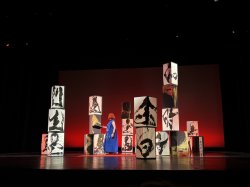
Following the dance performance, Japanese calligraphy artist Hiroko Watanabe took the stage. She began by placing foldable boxes around the stage, stacking them one by one. At first, the arrangement seemed random, with no clear pattern or purpose. But as the final pieces came together, the full structure was revealed. It was an installation that set the stage for her next act. Watanabe then used several blank boxes as her canvas, showcasing her skill in calligraphy. Her performance was beautifully synchronized with live music by composer Hozan Nomura, who played the syakuhachi (a traditional Japanese bamboo flute), and koto player Yuko Nomura. The music piece, PLATEAU OBJECTS, added a calm and dreamy feeling to the performance, bringing the sound and movement together in a special way.
Lastly, the show concluded with a performance titled Kyogen BUSSHI. This piece was a form of Kyogen, a traditional style of Japanese comedic theater that is known for its use of minimal props and exaggerated acting. Kyogen relies heavily on the imagination and attention of the audience. The plot centers on a countryman who travels to the city of Kyoto, over 500 years ago, in search of a Buddhist statue. However, he doesn’t know where to find the shop of a busshi (a Buddhist sculptor). A con man sees an opportunity and pretends to be a busshi, claiming he can make a statue for the countryman. The humor in the play depends on the timing, expressions, and delivery of the two actors, making it clear to the audience that this is a comedy. One especially unique feature of this performance was that the countryman spoke in English, while the con man spoke in Japanese. Despite the language difference, the audience was still able to follow the story and enjoy the humor. It was impressive how the performers were able to communicate so clearly and effectively with minimal props and a language barrier. The Trickster, performed in Japanese by Matasaburo Nomura XIV, and the Supporting Countryman, performed in English by Takayuki Noma, brought the scenes to life.
The YOHAKU performance gave Montclair State students and the community a chance to experience Japanese culture in many forms: film, dance, calligraphy, music, and theater. This event showed how art can connect people from different places and times, helping us understand and appreciate new cultures. By bringing performances like YOHAKU to campus, the Department of Theatre and Dance helps students learn about the world, sparks creativity, and encourages everyone to think in new ways. It’s a great reminder of how important it is to share stories and traditions from around the globe.