Dr. Fiore Presents on the Allied Landing in Sicily in Literature and Film at Frank Capra Film Fest (Bisacquino)
Posted in: CHSS News, Endowed Chair's Research, Global Cultural Studies, Teresa Fiore Research
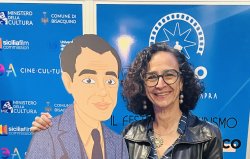
On May 29, 2026, Dr. Teresa Fiore (Inserra Chair in Italian and Italian American Studies, Global Cultural Studies) presented a paper on John Hersey’s novel A Bell for Adano (1944 Pulitzer Prize) and its adaptation to the big screen directed by Henry King in 1945, and also on Leonardo Sciascia’s short story “10 luglio ’43/Gary Cooper in Licata”, which features a clever cinematographic rendition of the arrival of the American forces on the Southern coast of Sicily that day. Part of a panel titled “Gli italo-americani e lo sbarco in Sicilia del 1943 nella letteratura e nel cinema,” the presentation was included in the Frank Capra Borgo Film Fest’s program.
This international short film festival, this year at its 3rd edition, was conceived to bring visibility to the mountainous village of Bisacquino, in the heart of Sicily, the birthplace of renowned director Frank Capra. At the panel, his WWII films were discussed by Elena Costa (Borgo Film Fest Artistic Director), as part of a broader conversation about Italian American literature (Prof. Laura Restuccia, University of Palermo), the ambiguous experience of the Sicilian population and Italian American soldiers at the time of the Landing (Alberto Oddo), and the relationships between film and photography during WWII with references to Robert Capa (Prof. Gennaro Schembri, University of Palermo).
The Film Festival includes screenings, round tables, and workshops, but also opportunities for social gatherings and cultural discoveries over an entire week (May 25-31, 2026). A walk around this quiet town reveals the presence of a Jewish community in the past, that of a monumental Catholic sanctuary (Madonna del Balzo), and a majestic natural spot, Mount Trona, full of history and legends. But the more obvious route for the film festival participants is the one that traces the key moments of Capra’s film career as well as the brief story of Capra in town through panels located around the village and documents exhibited at the Civic Museum. Capra was 5 years old when he was taken to the U.S. and returned only for a short visit at the age of 77, a very successful self-made man by then, but also an immigrant who was for long time part of a process of intense Americanization in institutional environments. The attachment to his Sicilian roots came late in his life and this fact continues to constitute the source of an interesting debate about identity, origin, migration, memory, and life goals.
Short link: tinyurl.com/FioreLandingCapra